Spatial Analysis to Underscore Density and Overcrowding
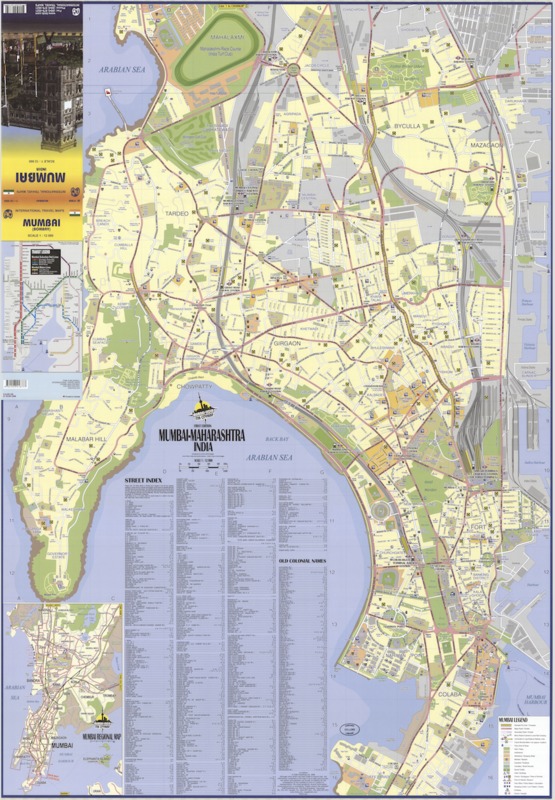
Through zooming out of the map and observing its qualities from a wider scope, a viewer can also gain valuable knowledge that the cartographer may have been trying to deliver. For example, when looking at an overview of the map as depicted, it is easy to see that the city of Mumbai is extremely dense. More specifically, the crowded conglomerate of institutions and tourist sites in the Southeast corner of the map shows the dense nature of the city, which can be translated into the overcrowding and dense population of its people as well.
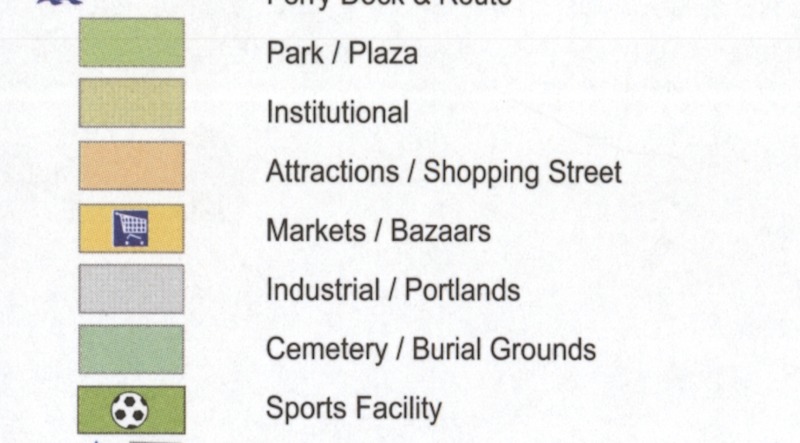
A portion of the map legend, as seen to the right, also divides the map into colored regional masses, which depict areas of industry, parks, institutions and more. A general spatial overview of these colored regions can reveal details about the city to the viewer. More specifically, gray regions, which represent industrial areas are mainly seen on the edges and borders of the map. Mumbai was once an extremely industry-heavy city and has experienced a shift in its economy from this industry to more globalized forms of economy and technology (1). Perhaps this depiction of industrial zones on the “outskirts” of the city depicted in this map further emphasizes the idea of Mumbai as a changing, dynamic and more globalized metropolis.
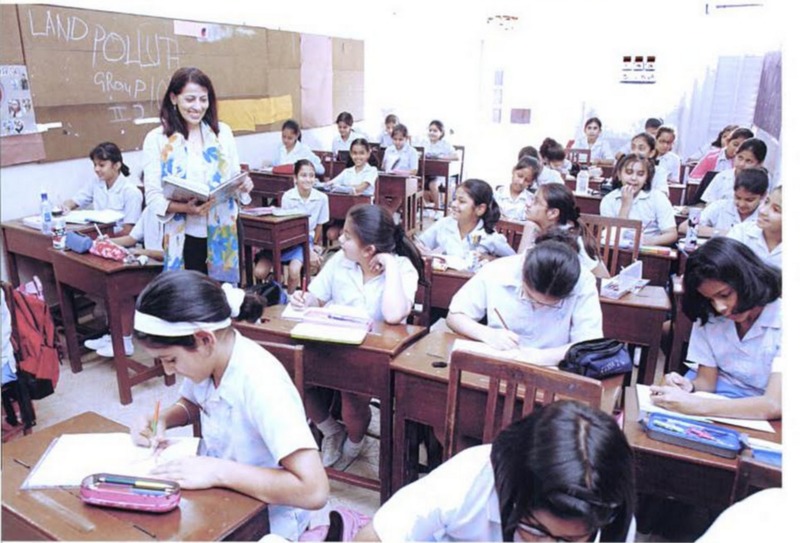
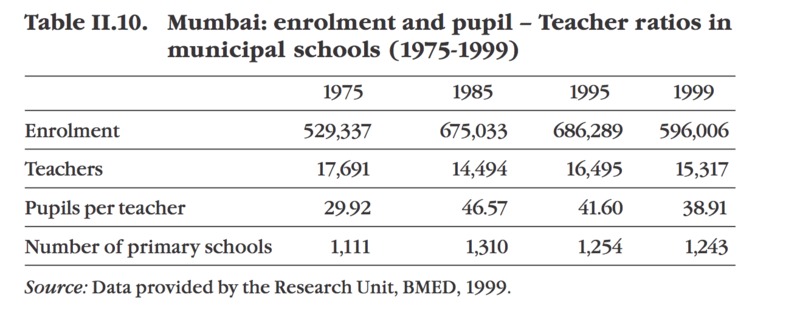
Lastly, the shortage of “Institutional” regions as marked by the mustard-colored areas through a large-scale spatial view of the map is particularly fascinating and revealing. Schools on the map are represented through this mustard-colored region as well as an “S” marking, but the map reveals very few schools for a city with such a dense and large population. A small prevalence of educational institutions in a region of the city with such high density and population insinuates potential overcrowding of existing institutions and schools. Further analysis into the educational system in Mumbai actually elucidates this exact situation. Because of overcrowding in the public school system, many middle-class and upper-class families prefer to send their children to private schools (2). As seen in the first figure to the left, classrooms in the city are cramped and crowded. The image actually depicts a private school classroom, which is considered less densely-packed than a public school (2). More formal statistics confirm these observations. According to a study done by the International Institute for Educational Planning through UNESCO (3), as seen in the lower figure, the pupil-teacher ratio has increased in the 1980s, and although it has decreased slightly in the years after, the ratio is still incredibly high as compared to other countries. For example, while the ratio hovers around 40 in Mumbai, the average pupil-teacher ratio in New York City is 17.8 (4).
Works Cited
1. Patel, Sujata. "Mumbai: The Mega-City of a Poor Country." The Blackwell City Reader (2002): 73-77.
2. Green, Jen, and Chris Fairclough. Mumbai. New York: Chelsea House, 2007. Print.
3. Juneja, Nalini. Primary Education for All in the City of Mumbai, India: The Challenge Set by Local Actors. Paris: International Institute for Educational Planning, 2001. UNESCO. 2011. Web.
4. Berger, Joseph. "Education; Is There an Optimum Class Size for Teaching?" The New York Times. The New York Times, 05 Apr. 1988. Web.