Holding Russia to Western Democratic Ideals at Bolotnaya Square
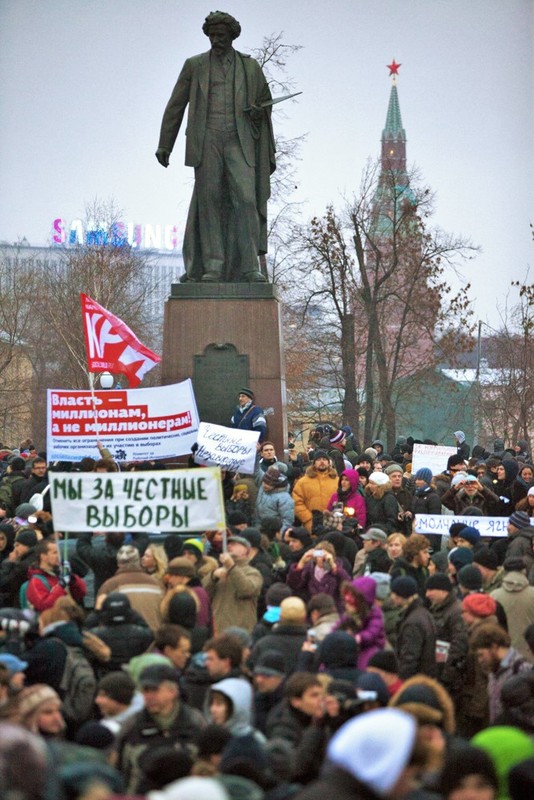
Bolotnaya Square was previously named Repin Square between 1962 and 1994, for its memorial statue of Ilya Repin. His statue remains to this day even after the renaming of the square. Ilya Repin was a Russian realist painter who had been trained in Europe. He employed European techniques in his paintings, and helped to introduce Russian art to a European audience.(1) While Bolotnaya Square is a visible site due to its central location, it also serves as a particularly powerful venue because Repin can be seen as a symbol of integrating elements of European culture into Russian culture. Similarly, the protests at Bolotnaya Square call for Western ideals of democracy to be applied and fostered in Russia.

On 10 December 2011, Bolotnaya Square saw “what is likely to be Moscow’s biggest demonstration since the fall of the Soviet Union”(2). For this first major incident of the 2011-2013 wave of Free Election demonstrations, the protesters made five demands, including freedom for political prisoners, an official investigation of vote fraud, new democratic and open elections, and registration of opposition parties.
Another major Free Election protest followed in Bolotnaya Square on 6 May 2012, when 20,000 protesters stormed the square to revoke Putin’s inauguration as President(3). This protest, subsequently dubbed “March of the Millions” or the “Bolotnaya Square Case,” triggered a criminal investigation by the Investigative Committee of the Russian Federation, arresting demonstrators for criminal riot and violence against police. The case was acknowledged for its political agenda both within Russia and internationally. The European Court of Human Rights and Amnesty International both released statements stating that innocent people were being arrested. This commentary from international agencies did influence the Russian government to release the prisoners by the end of 2013, a fitting end to a protest that took place at Repin’s memorial.
Citations
(1) Encyclopaedia Britannica Online. “Ilya Yefimovich Repin.”
(2) Amos, Howard. “Russian protests: December 10 as it happened.” The Telegraph, 10 Dec 2011.
(3) --. “Ombudsman supports idea to amnesty Bolotnaya Square riot case participants.” TASS, 20 Sep 2013.