Understanding Boston as a Palipmsest through Multimedia and Online Blogging
Boston as a Palimpsest
A palimpsest is “a manuscript or piece of writing on which later writing has been superimposed on effaced earlier writing” [1]. Many parts of Boston, a city with a rich history reflective closely tied to our nation’s, led itself easily to being a palimpsest. The city has a complex temporal layers: Boston symbolizes a place of religious freedom for settlers, of political freedom as the center of the American revolution, of crime and corruption in the 20th century, and today a place of great division between the haves (Boston Brahmins, the people of business, and the “town and gown” community) and the have-nots (who are not only socially and economically left out, but also geospatially separated). To study the city not only in this manner, we are able to take a physical space (or built environment) and see it as an experienced space. I explored the Soldiers and Sailors Monument in the Boston Commons as a palimpsest – how the timeless elements of the monument and the motifs it draws upon connected multiple generations of viewers.
Multi-Media and Blogging Boston
“People moving through the city at ground level write the ‘urban text’ without being able to read it. The city is provisionally created as a patchwork quilt of individual viewpoints and opinions. ‘The created order is everywhere punched and turn open by ellipses, drifts, and leaks of meaning: it is a sieve-order.” – Michel de Certeau “The Practice of Everyday Life” [2]
This class has been taught not only through a multidisciplinary lens using both literature and history, but also taught using multi-media sources. To discover the “patchwork quilt of individual viewpoints and opinions,” we have discovered the city through a wide range of mediums, ranging from memoirs to fiction to poems to films to songs [2]. Superficially, just as the sources that inform our understanding come from various mediums, our blog posts and Omeka essays easily showcase of our analysis and understanding with multi-media items.
Moreover, our understanding is enhanced by multimedia items: Through using different multi-media sources, we are able to discover the city differently as each medium lends itself to a different understanding. Given the same experience, if expressed through two different sources, all else being equal, we, as the audience, have a different second-experience of the city. I touched on the importance of using various multi-media sources to study the city in my blog post “Berlin: Individual Experience in Silent Film” where I examined how film and prose can show individual experiences differently. I contrasted Walter Ruttman’s film, Berlin: The Symphony of a Metropolis” to Alfred Doblin’s text, “Berlin Alexanderplatz.” Here we have not controlled for the exact experience, but both were set in Berlin and engaged with the format of montage. Through this blog post, I argued that with the text, it was easier to give backstory and internal thoughts to present the individual experience while the film had a more unobtrusive and comprehensive view of the city. (Admittedly, these conclusions were based on these two pieces – it is not to say that text always lends itself better to expressing individual experiences than film.) Uncontroversially, visual and acoustic representations of a story do add another layer of understanding than just textual representations.
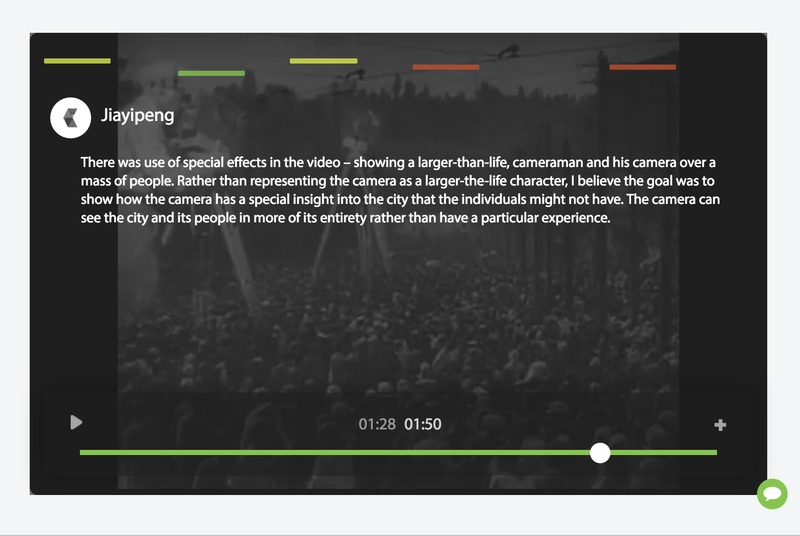
The ability to express ourselves in this course through blog posts made it easier for us to directly incorporate the multi-media sources. We are able to imbed not only quotes from texts, but also imbed pictures and videos, making a smoother discussion of the source material. In addition, the Critique tool, we used for our first blog assignment, allowed us to annotate the film directly like a text and share our thoughts with the class. With the Boston unit, we were able to visit the cites in person for our Omeka assignment and ability for online mediums to imbed multi-media sources became important as I was able to share videos I took of my experience at the Soldiers and Sailors monument – the atmosphere of the park, the acoustics of the park, etc.
The benefit over the tradition essay is not only the ability to more smoothly include these media items and the deeper understanding of the subject, but also the increased accessibility and broader audience brought by the online blog. There was a way for our class to read and respond to other people’s writings. Seeing the class’s individual and collective understanding of each unit is reflective of the theme of individual vs. collective understanding of the city. Similarly, the blog post creates a different audience in that we write for a broad audience and potentially a community outside of Harvard has access to our thoughts and analysis.
References
- “Palimpsest.” English Oxford Living Dictionary, https://en.oxforddictionaries.com/definition/palimpsest. Accessed 10 Dec. 2016.
- de Certeau, Michel. “The Practice of Everyday Life” The Blackwell Reader. p. 112- 118