Boston: Transformation of a District
Modernization and the transformation of districts and structures has played an important role in our understanding of various cities. In every city that we have discussed, the evolution of structures and whole districts has been included as a topic. This topic is key across the three sites, the New England Aquarium in Boston, the Narkomfin building in Moscow, and the Basilica Cistern in Istanbul. First, the site where the New England Aquarium has endured cataclysmic manifestation, largely due to the aquarium. The site on which the aquarium now sits has gone through many transformations, as the needs of the city and thus its people has manifested over the years.

In the Omeka exhibit, “The New England Aqarium and the Cultural Revival of the Wharves,” transformation is a central theme to the development of the district. At first, the Waterfront District in which the aquarium is located was an industrial center due to Boston’s expansion in trade and industrialization. Central Wharf was home to dozens of industrial warehouses, and was not a destination for consumers, residents, and visitors. The District had a strict industrial, trade, and business purpose. However, as time progressed and as the importance of the wharf and the district in terms of manufacturing power declined, the city sought other uses for it. Many of the industrial warehouses were removed, and leaders began to plan revitalization projects to the pretty empty Waterfront district.
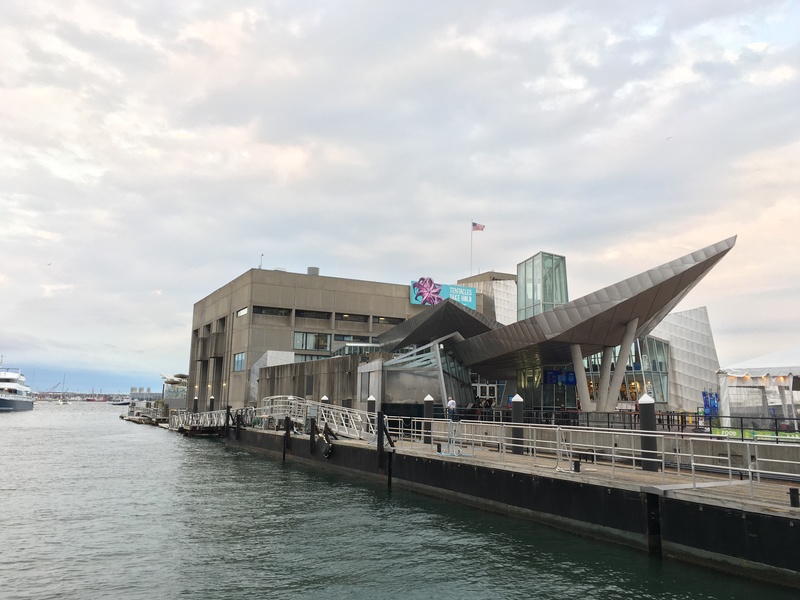
One monumental project which helped lead revival and which signaled a new era for the waterfront was the construction of the New England Aquarium. The aquarium essentially heralded a “New Boston” layer of city’s the palimpsest. Opening its doors in 1969, the structure breathed life into the previously empty lots, and its concrete, brutalist style architecture by Peter Chermayeff was a nod to modernity. Attracting visitors, students, money, and other revivalist structures, it can be argued that the aquarium almost single-handedly brought about the positive change seen on the wharves today. As Boston moved away from a trade and industrial oriented economy, the wharves were in need of modernization, or in need of a new societal purpose. With the influx of tourists and residents, the societal needs signaled a cultural, educational, and leisure spot, such as the aquarium. This modernization of the wharves and Waterfront district was cataclysmic for the city, offering new options for citizens and visitors alike, and ultimately bettering the fabric of the city itself.

The New England Aquarium embodies the characteristics of a “public space” or “public realm” described by Sennett. The aquarium and subsequent revitalization and pedestrian friendly meeting grounds of the wharf and Waterfront district provides a space for strangers to meet, communicate, and learn in public. It is an example of a vibrant center that Hannah Arendt describes, with its hotspot of dining, educational, shopping, and transportation options. Unlike in a closed structure, authorities and planners were able to successfully transform this district to fit modern uses and to fit a changing Bostonian society, one away from trade, and one more focused on consumers and tourists. This new center is a perfect example of a public space that improved the sense of community within the city of Boston.
- Paulhus, Derek. The New England Aqarium and the Cultural Revival of the Wharves. Omeka RSS, n.d. Web. 09 Dec. 2016.
-
Sennett, Richard. The Public Realm. Blackwell City Reader, Second Edition. 2012. Ed. Gary Bridge & Sophie Watson.