Moscow Kurskaya: Peripatetic by Nature

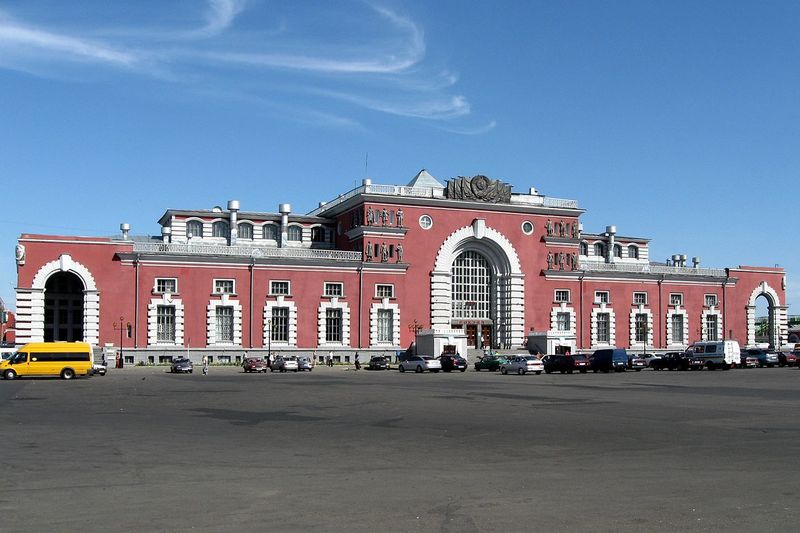
Kursky station serves as Moscow's terminal to Southern Russia, the Caucasus mountains, Eastern Ukraine, and Crimea. Mirroring the fluidity of the regions it serves, Kursky station is described by the Russian Railways as "peripatetic" (1).
Originally referred to as the Nizhny-Novgorod station when it was first built in 1865, Kursky was the only railway station built outside of Moscow's city limits at the time. This first station was considered temporary by the tsarist government and meant to merely fill the need of travel to Southern Russia and the Ukraine. In 1896, the temporary station closed down and its services officially switched over to the newly built Kursky station (1).
When the Russian Railways describes Kursky station as peripatetic, they mean simply that Kursky moved from a temporary location to a permanent one. However, deconstructing this idea of a peripatetic station, especially since this station services the Ukraine and Crimea, two historical powder kegs in Eastern Europe, should be illustrative of Russian imperial tendencies.
When the Soviet Union fell in the 1990s, all of the Soviet satellite states declared independence from Russia. These satellite states had been under Russia's jurisdiction essentially since the Russian empire and the tsars. Despite uprisings and occasional coups, Russia and the tsars mainted control of these states and established a lasting tendency that extended well into the 20th century.
As Andreas Kappeler writes, "many Russians...are suffering from the lost status as a great power. There is a wide-spread nostalgia for the tsarist Empire and Soviet Union," (2). Kappeler attributes the loss of so much classically Russian land at the end of the USSR to Russia's current penchant for meddling in the post-Soviet space, particularly the "near-abroad" such as the Ukraine, Crimea, and the Caucasus (2). Looking at current events, it is clear that Russia's tendency to assert control and influence over this region has not waned at all, with the nation annexing Crimea from Ukraine as recently as 2014.
Kursky station is an extremely important railway station for both tsarist and modern Russia because it is the start of a journey to one of the most controversial international regions in the world. The fact that the station is described as peripatetic and moving from one space to another is wholly reminiscent of Kursky's destinations. These countries and regions are moving from regime to regime as a result of military action, much like Kursky moved from one space to another.
We can begin to understand how tsarist tendencies toward expansion of the Russian empire created a state of constant flux in the far reaches of the empire. To this day, controversial land grabs and annexations occur as nations battle over resources and ports because of military and economic strategy. Kursky station acts as a means to stoke these controversies, as it sends soldiers to Southern Russia and Eastern Ukraine. Despite being geographically separated from the borders of the empire, perhaps the dynamic issue of border expansion and imperial ambitions followed the railway route from Southern Russia and Eastern Europe into the heart of Moscow and made Kursky station itself a reflection of the provinces it serves.