The Two Red Gates

Traveling east on the Garden Ring, we come to our final destination: the former site of the Red Gate, or Krasnye Vorota. Like the Sukharev Tower, its physical absence belies its presence in the symbolic language of the surrounding area. The nearby metro stop is named “Krasnye Vorota,” and the towering skyscraper next door—one of Stalin’s “Seven Sisters”—bears the same name.

The latter is especially remarkable, given the history of the original Red Gate. One of a series of triumphal arches in Moscow, it was built to commemorate the coronation of Tsarina Elizabeth Petrovna in 1742, and replaced with a stone copy in 1753. As well as being an emblem of imperial rule, it also held religious significance: historian John Gerrard argues that the various Krasnye gates were “replete with sacred meaning to the Orthodox believer” [1]. This double status as imperial symbol and religious icon practically guaranteed its removal in 1927, ostensibly to make way for the expanding Garden Ring.
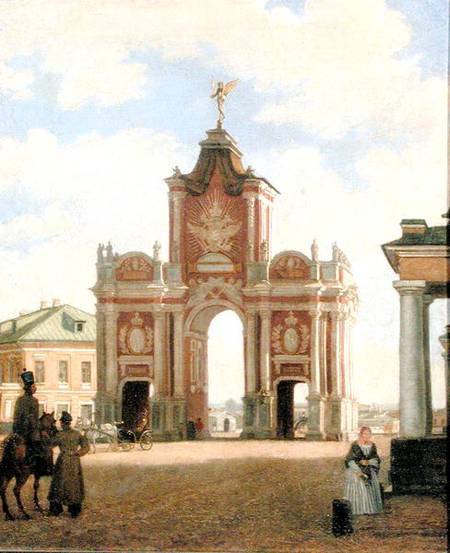
The Soviets’ demolition of the Red Gate was therefore conducted for both symbolic and practical reasons, in order to legitimize the new regime and its “master plan” for the city. The gate was so integral to Moscow culture, however, that its replacement was quickly dubbed the “Red Gate Building,” despite being intended to signify Stalinist authority. Ninety years after its destruction, the Red Gate continues to occupy its former site, if only as a memory.
- Garrard, John Gordon., and Garrard, Carol. Russian Orthodoxy Resurgent : Faith and Power in the New Russia. Princeton: Princeton UP, 2008. Google Books. Web: 23 October 2016.