The Ultimate Palimpsest

The ultimate link between the past Boston and today’s is the June 20, 2016 Archaeological Dig that took place at the Old North Church. The City Archaeologist, Joseph Bagley, and his team had previously conducted a study in 2013. They had done that prior study at the Clough House (from 1715), which is at 21 Unity Street. In that study, over 40,000 artifacts were found and they spanned as far back as 300 years. This dig began at Washington Garden behind the church and was an exploration of previous inhabitants’ backyards, privies, and outhouses.
“This is a wonderful opportunity for us to celebrate and explore the daily lives of the many immigrant peoples that lived in these apartments,” said City Archaeologist Joseph Bagley. “Until the 1930s, the garden was the location of three brick apartment buildings built in the 1830s, so this survey will give us a glimpse into over a hundred years of Boston’s history.”
Quote taken from "Mayor Walsh announces archaeological survey at Old North Church,"
published by the Mayor's Press Office on June 20, 2016
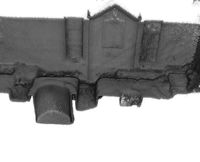
This 3D scan of the excavation site shows what the tenement behind the Old North Church would have looked like once upon a time. The use of modern technology to literally recreate the layers of the land capture the site's significance as a palimpsest, showing the different layers of history that contributed to the church's development over time.
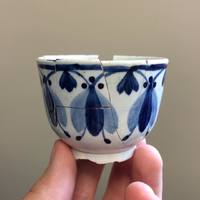
The pieces of the pearlware bowl that are reconstructed conjure to mind the imagery of de Certeau's quote, where order has been torn apart. There are many pieces of history that have been shattered and broken over time, only to be found and reassembled into something orderly, with a clear form. In many ways, this is a visual representation of history because different fragments can be combined together to tell entire stories.
Returning to de Certeau's quote, we can see different patches in the Old North Church that form the patchwork quilt that he describes.
There are not only physical remnants from the past that can be dug out in the present day - there are also memories and retellings that bring us back to different eras of the past.
Some of these retellings and memories build on others, such as Longfellow's poem, which connects the Revolution and the Civil War. Others are contradictory, such as the beginning of the Revolution at the church, which had been a branch of the English church.
Ultimately, this church and the urban palimpsest it forms embodies what de Certeau describes in "The Practice of Everyday Life." While people move through the space and contribute to the "urban text" without reading it, the many layers remain to be read by those who follow later in time.

The full photos on the Instagram account can be found here and include descriptions of each artifact that was found.