Struggle for the Bulgarian Exarchate
In evaluating St Stephen’s Church of the Bulgars as a lieu de memoire, it is first important to understand how the Church came into being. Where now the Church serves the purpose of being a place for locals to worship, it was formerly far more significant in representing a break away from the Ottoman Empire by the Bulgarian population.
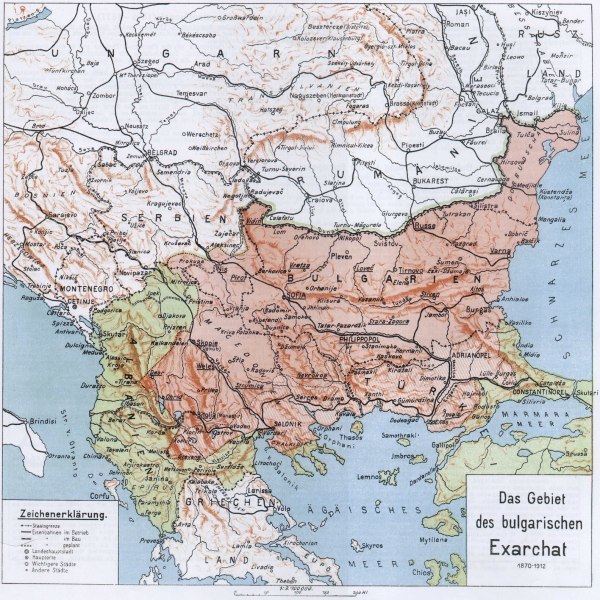
The ability of the Bulgarians to found their own church in what was then known as Constantinople, the capital of the Ottomman Empire, was an initial step to the formation of the Bulgarian Exarchate. In fact, ‘the first breakthrough [for the Bulgarian Exarchate] came in 1849 when the Ottoman government permitted the Bulgarians to build a church in Constantinople, which was to conduct services in Bulgarian, be run by a Bulgarian council, and be owned by the Bulgarian people’[1]. This signifies the birth of St Stephen’s Church of the Bulgars’ role as a lieu de memoire, in that it was the birthplace of the Bulgarian Exarchate.

During these early phases, the Church ‘was a small wooden structure’[2], although the remarkable significance of its existence proved that much was left in store for the site. It is interesting to remark that, at the height of the Church’s significance, its physical appearance was at its very lowest. This supports Nora’s idea, in that the sites that embody the concept of a lieu de memoire are those that evolve over time. In a sense, the future of the physical structure of the Church could be seen as the ‘anticipated commemoration’[3] that Nora discusses.
[1] Varnava, Andrekos; Michael, Michalis N; The Archbishops of Cyprus in the Modern Age: The Changing Role of the Archbishop-Ethnarch, their Identities and Politics, Cambridge Scholars Publishing, 2013, p 112
[2] Piegsa, Inka, Istanbul: City of the Green-Eyed Beauty, Amazon Digital Serices, 2014
[3] Nora, Pierre, 'Between Memory and History: Les Lieux de Memoires', University of California Press, 1989