An Overture to the City

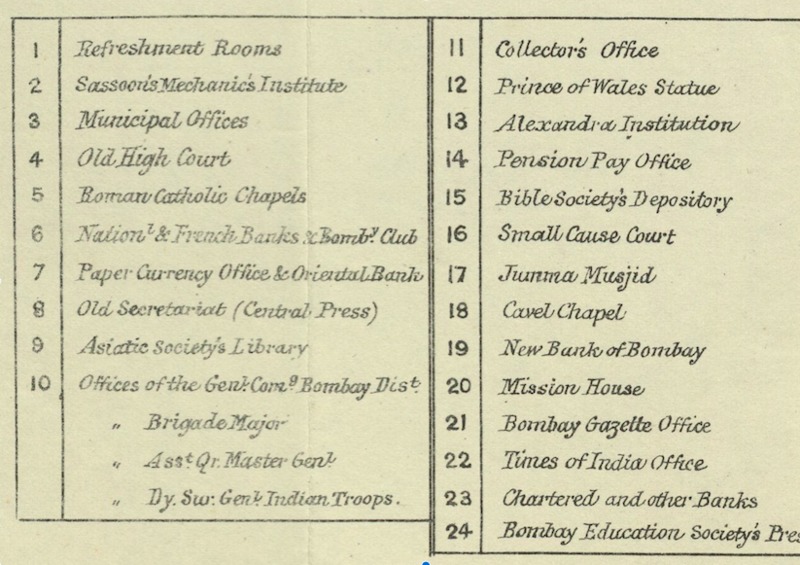
This map of Bombay is from 1885, and it was made by rich Englishmen for rich Englishmen. It is indeed a “written” text of the city, and de Certeau’s idea of the “Wändersmanner” does not go far enough to explain it. It more fits a category of an urban poem or verse that was intentionally written and legible. It is a premeditated work with goals, and it aims to frame either a view of Bombay or a trip there. In this way, it is the “overture” to the city. It primes themes to come in the city, and it prefaces opinions made on the city before a tourist even visits. In the case of a map, urban imagination is required to predict what will come after the overture, and only more exploration can lead to that discovery.
This map highlights the existence of financial landmarks such as banks, a currency office, a pension pay office, the collector’s office, and so on. This primes the theme of Bombay as a lucrative initiative of England in the “overture.” The themes this overture initiated were perhaps biased to the audience they expected to “listen.” In this respect, some categories of institutions were highlighted in the map that prioritize that audience. For example, many Roman Catholic churches are displayed on the map, despite the rich Hindu and Muslim cultures that were occupying much of the space at the time.
Indeed it is important to keep in mind that while some departments such as English investment and the Roman Catholic Church are audible in the “overture” reading of this map, many things were much more quiet or even absent altogether from the orchestra.