Encouragement for the Expression of Islam
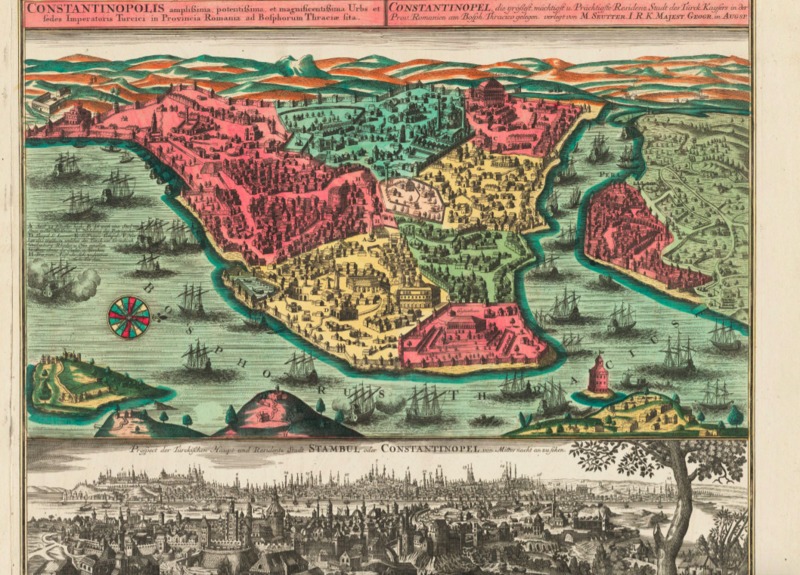

The end of the 15th century was a prime time in the age of discovery. There was the famous 1492 Christobal Columbus arrival in America, commissioned by the Spanish throne, the Vasco de Gama tour from Portugal to Africa, and mercantilism and colonialism elsewhere in the world. The Ottoman Empire was no different. The ruler of the Ottoman Empire was Mehmed II the Conqueror claimed the Byzantine Empire and repurposed it as Constantinople (later known as Istanbul). (1)
In 1491, when the Galata Mevlevihanesi house was built, Constantinople was just recently christened as its new city in 1451.(1) This era for the city was a time for new beginnings, and one piece of evidence supporting that is the construction of the Galata Mevlevihanesi house. This house was started as a lodge for Islamic practices and ceremonial grounds, a religious place above all. Indeed its origins were inspired by Mehmed II’s great appreciation for the Islamic faith.
As a result, the Galata Mevlevihanesi was built to be “functional” and “symbolic,” in Nora’s terms. It was both functional as a lodge for spiritual leaders, but also as a place to symbolize that Constantinople was a place with a Muslim population. It was the first tekke (dervish lodge) to be erected in the city.
(1) İnalcik, H. (1977) ‘The emergence of the Ottomans’, in Holt, P.M., Lambton, A.K.S., and Lewis, B. (eds.) The Cambridge History of Islam:. Cambridge: Cambridge University Press, pp. 263–292.