An Obviously British Perspective
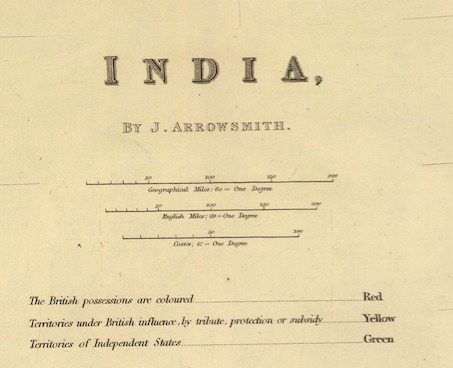
Next, let’s have look into the legend of the map, which focuses on the different colors in which India is dvided. As it reads, the colors all correspond to who ruled which part of the country: red is under direct British rule; yellow under a “British influence”; and green an independent state. Unsurprisingly, there is hardly any green, considering that most of the country was, indeed, under British rule. Bombay itself is in a sea of red, serving as a reminder that the state of Maharashtra (in which the city of Bombay resides) was occupied by the British.
Colors are a very important tool used in maps, especially in a map like this—upon a first look, one's eyes are drawn to the different colors, and one might immediately wonder what they represent. The fact that it splits up the country in different "types" of British rule is a sign that the British might have made this map as a victory trophy to the lands they owned.
It’s interesting to consider how this map might have been this been made by an Indian cartographer and for an Indian audience. Would both the red and the yellow territories have existed, or would an Indian resident see no imperial difference between “British possessions” and “British influence, by tribute, protection, or subsidy”? For an Indian person, both might be equal cases of imperialism—cultural or literal—and thus, this key difference present by Arrowsmith is yet another way that the map is clearly painted in an Anglicized way.