(Mis?)spellings
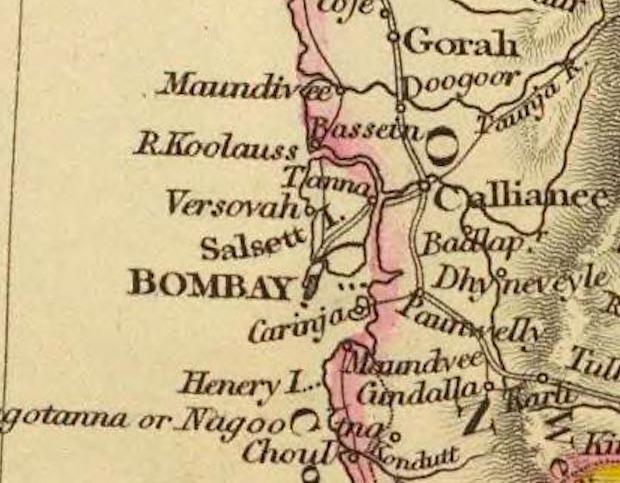
Using these initial observations, it’s helpful to zoom into Bombay itself, the city at fascination here. Many names float around it: Salsett, Versovah, Carinja, Badlap, amongst others, are all seen nearby. An initial look at this begs some questions: what do these words mean? Are these spellings that Indian natives would use, or might they be an English version of these words? Are these places still in existence today, and are they still called the same?
Therefore, a closer look into these places today provided major insight. Salsett, spelled “Salsette" today, refers to an island on which Mumbai rests on, and is today one of the most densely populated islands in the world. Versova—now “Versovah”—is actually just an upscale neighborhood in Mumbai today. The “Carinja” on the map is actually referring to “Karanja,” a city that neighbors Mumbai. And finally, Badlap refers to “Badlapur” today, which is another state in Maharashtra.
Since Arrowsmith's map is not great at scale, it's helpful to look at these various places on a map today. Thus, refer to the Google MyMaps below for their relative distances. This also helps provide some scale to the historical map in question.
However, to actually understand whether or not this was actually an Anglicized version of various spellings, it is helpful to have a look at other maps of India that were published around the same time. Below is a map from 1857, so roughly nearly around the same time:
However, to actually understand whether or not this was actually an Anglicized version of various spellings, it is helpful to have a look at other maps of India that were published around the same time. Below is a map from 1857, so roughly nearly around the same time:

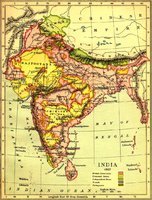
A closer look into Bombay is very revealing, as it has different spellings of the names we see in Arrowsmith’s map:
A closer look into Bombay is very revealing, as it has different spellings of the names we see in Arrowsmith’s map:

Salsette, as it is called today, is spelled the same way in this 1857 map, while Arrowsmith’s map had it referred to as “Salsett.” While the other aforementioned names are not present here, this is already helpful insight that Arrowsmith was using English spellings for the colonized lands.
Salsette, as it is called today, is spelled the same way in this 1857 map, while Arrowsmith’s map had it referred to as “Salsett.” While the other aforementioned names are not present here, this is already helpful insight that Arrowsmith was using English spellings for the colonized lands.