The Map Up Close
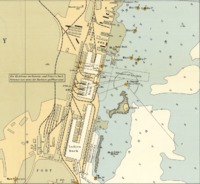
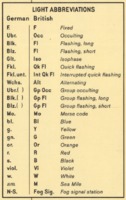
This maritime map is particularly difficult to read for two reasons. First, much of the map is written in German. Both German and British abbreviations are translated into English in the key denoting color of the lights in the lighthouse, yet some of the information requires outside translation into English from German. Even more difficult is information provided by German abbreviations without translation or indication of the complete German word. Second, many of the symbols used throughout the map are used without a visible key. A note to the viewer in the bottom right hand corner of the first map indicates, "For signs and abbreviations see map no.1." As map no.1 is not available in this particular archive, it is difficult to read many of the symbols provided on the map. Still, this may be a good place to begin an investigation of the map. In order for this map to be useful, the viewer must have had either ready access to Map no.1 in the collection, or would have had to have prior knowledge of the cartographical system at hand. In other words, this map must have been not only one in a series, but one in a series that was in use by the viewer. Perhaps the map was part of a larger maritime navigation system covering major ports, which would have been used uniformly by certain ship operators.
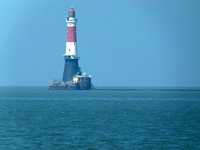
Still, some information was included in a key to this map alone. For example, in the right hand corner of the right hand map, there is a key that includes the colors and patterns of the lights emitted from the lighthouses pictured on the map. On the map itself, the lighthouses are emphasized using small orange dots - the only color on the map that steps out of its neutral and pale blue-green color pallet. Beyond that, the lines extending out from the lighthouses seem to denote direction and radius of the projected light. The visual attention cast on the lighthouses in the map suggest that the viewer might rely on the continued operation of the lighthouses, denoting some degree of cooperation between the viewer of the map and operations at the Mumbai Port.
Further, the viewer will find that the map is divided into two separate maps. The focus of both maps is not the city but the way into and out of the city. An expansive white artery cuts through the center of both maps. This artery, a very specific kind of focal point for a map of Mumbai, denotes the area deep enough for ships to pass through with ease. Additionally, small numbers are penciled in denoting the depth of the water at their location. The sheer volume of these numbers, as well as their attempted accuracy to the tenth of a meter (the German reads Hohen und Tiefen in Metern, meaning "Highs and lows in meters " or "elevations in meters," while the numbers are presented with subscript numbers next to them, which seem to me to be decimals. Ex: 12 would denote 1.2 meters deep) marks the importance of the pathway for the ships entering and leaving the port. The Port is the only place in which the white area, denoting deep enough water for ships to tread extends out of the estuary and toward land, hence the building of the port here rather than elsewhere along the coast: ships are able to pass in and out because of the naturally deep area extending toward land. The map's focus on the depth of the water illuminates its design as a navigational map with its focus on keeping the ship at hand in safe waters coming into and out of the port.
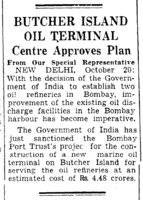
On the other hand, the map also marks an attempt to keep up with a quickly changing port geography. The white, deep-water area extends north-east through Butcher and Elephanta Island's, remaining deep as it approaches the land at Butcher Island. According to the Mumbai Port Trust, the Trust commissioned a Marine Oil Terminal at Butcher Island with three jetties for handling large crude and POL tankers. Unlike the natural port at Mumbai, this port required dredging, or digging down to make the water deeper in order for ships to be able to dock. The image to the left marks a 1952 issue of a Times of India announcement of the coming Butcher Island Oil Terminal, to accompany the city's pending Oil Refineries. According to The Design and Construction of Bombay Marine Oil Terminal, written by Partners and Former Chief Engineer of the Bombay Port Trust in 1961, "The construction of refineries at Bombay necessitated rapid improvements to the Port's oil-handling facilites. After extensive site investigation, it was decided to build an entirely new Marine Oil Terminal at Butcher Island, connected to the mainland by 2 1/3 miles of submarine pipeline... Work started in October 1953 and the first tanker was berthed in February 1955." Perhaps the map's publication in 1956 is a result of the changing port geography, and a possible indicator of the type of navigators intended as the map's audience.
While the two maps represent the same area, the map to the left is presented at a scale of 1:50,000, the right at 1:20,000. As a result, the map to the left presents the entire peninsula on which Mumbai rests, exposing its western coast in addition to its eastern coast. By including the two maps in the same visual space, we can tell that it may have been necessary for the viewer to go back and forth between the two, not only to navigate within the Mumbai port, but into the Mumbai port from elsewhere in the world. Further, the left hand map does not present a strictly zoomed out vision of the right hand map in similar square format, nor does it extend West, deeper into the ocean to take on a horizontal format, than might have been oriented just as easily above or below the second map. Rather, it extends south to expose more of the eastern coastline of India. The map technically orients the incoming ship by providing landed markers for navigation and creating a seamless attachment to other maps that might have been used in either in the same trip, or in prior trips, which would have established the way in which to read this one. But the formatting choice also represents an attempt contextualize Mumbai, to situate within a larger Indian and global context. In short, the orientation of the left hand map suggests that this map represents a language between maker and viewer; but it is also a recognition that the city is part of something larger; a larger land mass, a larger atlas, a larger trend in the world economy. This map was made specifically for navigational use, by specific navigators who would have been familiar with its style, but it is also an equalizing force, putting Mubai on the same footing with other growing cities in a post World War II world. The map expressed a deep anxiety and attempt to reconcile campitalism and a burgeoning, post-war socialistic sentiment, efficiency (as in the map's content as a port navigator) and equality (as in the map's borderline monotonous depiction of the variegated and developed landmasses, as well as its attempt to contexualize the city as part of something larger than itself, something that operates on both an microscopic, insular, self sufficient level, and something that operates on a zoomed ou level, intraconnected with the larger world). In this way, the map rises above its functional use to tell us something about the time and context in which it was created.
"History in Detail." MUMBAI PORT TRUST (n.d.): n. pag. Web. 24 Nov. 2016.
White, Bruce Gordon, Sir, Colin Robert White, Allan Harry Beckett, and Pestonji Edulji Golvala. "No Access THE DESIGN AND CONSTRUCTION OF BOMBAY MARINE OIL TERMINAL." Proceedings of the Institution of Civil Engineers (n.d.): n. pag. ICE Virtual Library. Web. 24 Nov. 2016. <http://www.icevirtuallibrary.com/doi/abs/10.1680/iicep.1961.11530>.