Introduction
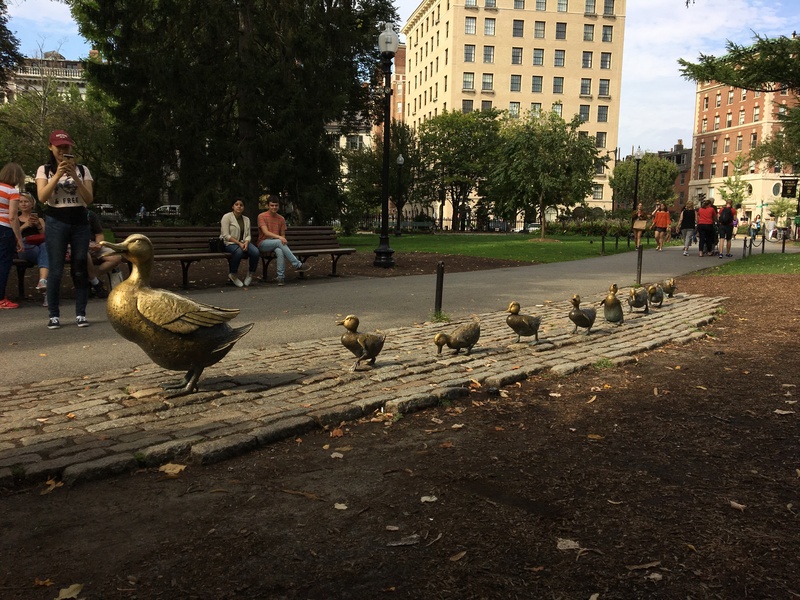
The warm weather and sun has pulled tourists and natives alike to Boston Common and the Public Garden today. The heavy air is saturated with the ease of Friday afternoons. Kids play soccer, couples lounge on the grass, and families walk their dogs. As I stroll into the Public Garden from Charles Street, it’s not long before I spot them. As a crowd of tourists parts, I see the nine, slightly larger-than-life, bronze mallards glistening in the autumn sun. Nostalgia seeps through me. It’s been a month since I’ve been home, and these statues are a reminder of first grade field trips, outings to Boston with my friends, and most of all, storytime with my parents.


When looking directly at the Make Way for Ducklings statue, it’s noticeably representative of Boston and its culture, yet it doesn’t seem to convey the temporal layers of the city’s history. However, when taking a step back and viewing the ducklings as a piece of the Public Garden and its surrounding area, it’s clear that it’s part of a larger palimpsest. In The Practice of Everyday Life, Michel de Certeau explains that “people moving through the city at a ground level write the ‘urban text’ without being able to read it. The city is provisionally created as a patchwork quilt of individual viewpoints and opinion. ‘The created order is everywhere punched and torn open by ellipses, drifts, and leaks of meaning: it is a sieve-order.’” So at “ground level”, the ducklings may not seem as significant as they are when seen as a part of the larger picture. While the duckling statue itself may not be a traditional palimpsest, its site has transitory qualities that contribute to the city’s palimpsestic nature as a whole.