Who Visits the Ducklings?

The duckling statue is understated. Unlike its fellow landmarks in the Public Garden, the ducklings are short and spread out— they aren’t visually distinct. In fact, due to their placement on a cobblestone patch next to the walkway, many passerby don’t even realize that they ducklings are there. However, there are plenty of people who do notice the statues, and there are a plethora of people come into the garden with as much enthusiasm for visiting the ducklings as for visiting the other landmarks. Since the duckling statue is a site for people of all ages, it serves as a palimpsest of generations. Although it was installed not even thirty years ago, it has a timeless quality that appeals to people of all ages. Its seamless integration into the park’s walkway allows it to be easily approached. This literal accessibility reflects figurative accessibility, which is apparent through the range of people who connect and enjoy the statue.

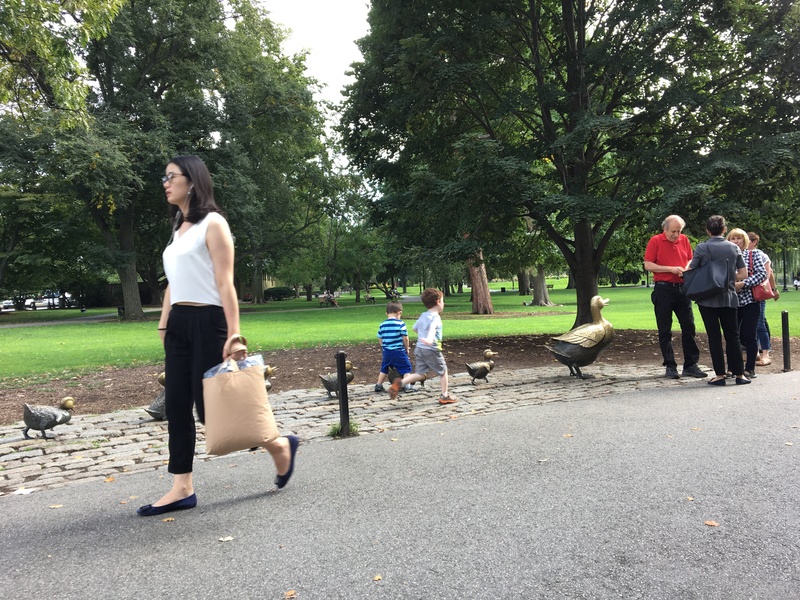
The friendly nature of the ducklings not only attracts people of all ages, it attracts people of diverse cultures and backgrounds. When visiting the ducklings, various languages can be heard admiring the statues. People from all over the world stop to photograph themselves with the ducklings. In this way, the site is reflective of Boston as a city growing on a global scale. The international presence at the statue is also reflective of the growing diversity in Boston. People who come from different cultures are all able to share the common experience of enjoying the ducklings. The idea of individuals contributing to a shared experience is conveyed by de Certeau: “the networks of these moving, intersecting writings compose a manifold story that has neither author nor spectator.” De Certeau suggests that the story of a place is created by the networking of individual ones. As people congregate at the ducklings and in the Public Garden, their stories overlap and also superimpose onto the site. This network of changing passerby over time depicts the palimpsestic quality of the duckling statue. As people interact with the statues, they each leave individual imprints of their lives on the site. Though these individual impressions may not be significant, as a whole, they build onto the history of the Public Garden.