Moscow: The Third Rome
The Third Rome refers to a nickname given to Moscow after it succeeded Rome and Istanbul as the capital of Christianity. It emphasizes the significance of the Russian Orthodox Church to Moscow.
Constructed after the fall of the Soviet Union (1991), Post-Soviet churches will be our main focus of analysis and will contribute to our understanding of Moscow as a palimpsest. Through examining the pre-communist, communist, and post-Soviet eras, these churches will portray the dynamic role that political institutions have had on the architectural layers of the city.

Pre-Communist Era
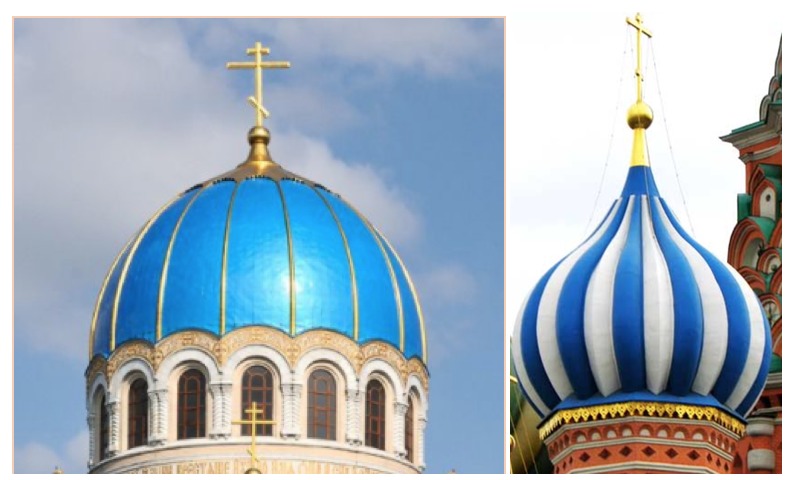
As the foundation of the city’s palimpsest, pre-communist churches contribute a defining architectural layer to the urban landscape of Moscow. Established in 1448, the Russian Orthodox church, for much of its existence, was heavily associated with the political, social, and economic affairs of the country. Churches during this era were constructed to commemorate military victories, assert religious piety, and most importantly, reflect the magnificence of the country. Constructed in 1561, Saint Basil’s Cathedral is one of the most iconic examples of a pre-communist Russian Orthodox church (1). Commissioned by Ivan the Terrible to celebrate his military victory in Kazan and Astrakhan, Saint Basil’s introduced several architectural traditions into Russian Orthodox church design. The most notable of which are the vibrantly colored onion-shaped domes. These onion-shaped domes replaced the earlier hemispherical Byzantine domes and remain an influential part of later church designs (2). Because of this, the architectural features of these pre-communist churches serve as a defining layer of Moscow’s palimpsest.

Communist Era
In 1917, when the communist government gained control, it withdrew its support from the church, adding another notable layer to Moscow’s palimpsest. The implications of this separation of church and state are most evident in the Cathedral of Christ the Saviour. Built in 1883 to commemorate Alexander I’s military victory, the cathedral was one of the tallest monuments in Moscow (3). Because Stalin believed that the church had a significant influence on society, he “decided to demolish religious influences across the country and replace them with those that stood for communist values” (4). As a result, the Cathedral of Christ the Saviour was demolished in 1931.
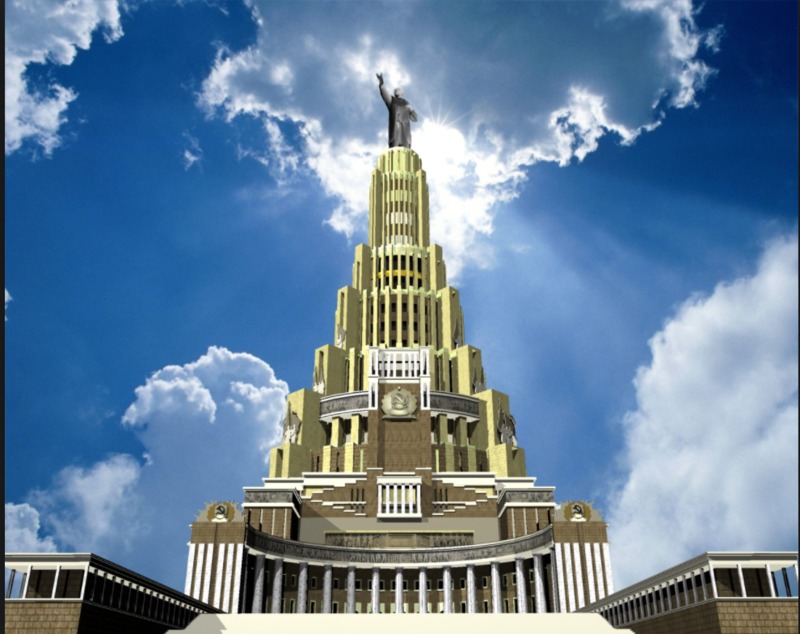

In its place, Stalin began plans to construct the Palace of Soviets, a governmental center that would have been the tallest structure in the world. Furthermore, Stalin also completed several ambitious infrastructure projects around the city like the Seven Sisters, the Moscow canal, and even the opulent metro system. To Stalin, these grandiose projects represented the power of communism in Russia.
Creating imposing communist structures is a common idea in some of the films that we’ve studied. For example, in New Moscow, the film presents a satirical view on many of the communist structures proposed under Stalin’s ambitious reconstruction plans. Through depicting imposing buildings like the Palace of Soviets and several completed infrastructure projects (bridges, buildings, prospects), the film highlights Moscow’s grandiose and formidable structural development under the communist era (5). As evidenced by the destruction of the Cathedral of Christ the Saviour and the construction of many Soviet style buildings, the communist era added another significant architectural layer to Moscow’s palimpsest.
Post-Soviet Era
When the communist government collapsed in 1991, the Russian Orthodox Church began to regain influence over society, reflecting another layer of the city’s palimpsest. For many Russians, the church “fill[ed] the ideological vacuum left by the end of communism” (6) As a result, the city began reconstructing previously demolished churches and initiated a massive religious infrastructure program. For example, in 1995, the city government decided to reconstruct the Cathedral of Christ the Saviour on its original site. Most recently, the government instituted the 200 Churches Program – an initiative to construct 200 churches in Moscow’s suburbs over the next 20 years (7).
In combination, the, pre-communist, communist, and post-Soviet eras contribute various defining layers to the city’s palimpsest. Although Moscow has experienced multiple political governments, the Russian Orthodox Church has always been an integral role in the urban landscape of the city’s palimpsest.
1) Popova, Anna. "Russia's Best-known Church." Russia Beyond The Headlines. N.p., 12 July 2016. Web. 23 Oct. 2016.
2) Jackson, Thomas Graham. Byzantine and Romanesque Architecture. New York: Hacker Art, 1975. Print.
3) "The Cathedral of Christ the Saviour." Moscow's Cathedral of Christ the Savior. N.p., n.d. Web. 23 Oct. 2016.
4) Jin, Peter. "Post Soviet Churches: The Tallest Orthodox Church." Omeka RSS. N.p., 9 Oct. 2016. Web. 09 Dec. 2016.
5) New Moscow. Dir. Aleksandr Medvedkin. Youtube, 1938. Web. 9 Dec. 2016.
6) Clover, Charles. "Russia's Church Mourns Patriarch." Financial Times. N.p., 05 Dec. 2008. Web. 23 Oct. 2016.
7) Vasílieva, Anna. "200 New Orthodox Churches in Moscow." Russia Beyond The Headlines. N.p., 26 Mar. 2013. Web. 23 Oct. 2016.