Cities and Names: Open Systems
In The Death and Life of Great American Cities, Jane Jacobs advances a radically different approach to urban planning from Le Corbusier. She argues that cities should provide the conditions for their their street-level communities to develop organically, into a densely interwoven “urban ballet” [1]. “You can’t make people use streets they have no reason to use,” she argues. “The safety of the street works best, most casually, and with least frequent taint of hostility or suspicion precisely where people are using and most enjoying the city streets voluntarily.”
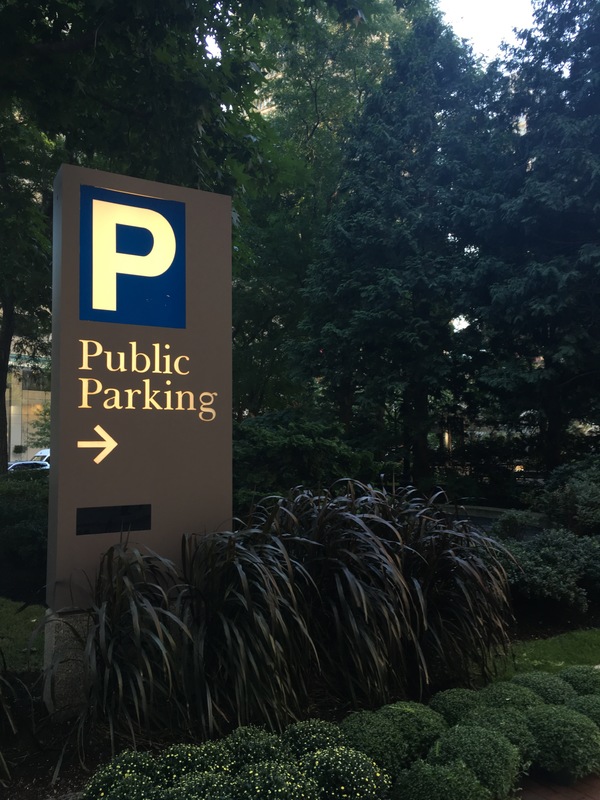
This emphasis on voluntary participation over control is echoed by my analysis of Post Office Park, the replacement to Post Office Square’s old garage. Marked by its accommodation of both foot and road traffic through a concealed parking garage, the park serves as a pleasing and open enclave for the surrounding community. Per Jacobs’ argument, it relies on porous boundaries and voluntary participation to generate a diverse community, attracting pedestrians with its physical beauty and practical amenities rather than forcing them in.

Another example of an open urban system is far older. The Fatih Camii in Istanbul, which I discussed for my third unit assignment, is a counterexample to the “closed” opacity that Richard Sennett identifies in more recent monuments. “[U]p to modern times,” he writes, “these monuments were meant equally to be used… the great medieval cathedrals were also productive centers for the propagation and distribution of herbal medicines, as an easy mixture of the sacred and the profane” [2]. As a mosque, the Fatih Camii filled an analogous role to these cathedrals in Ottoman-era Istanbul. Its structure was a kulliye (or mixed-use complex) that included several learning centers, a library, a hospital, a public kitchen, and a mausoleum. Like Post Office Square, it invites city dwellers to voluntarily participate in its community. And its emphasis on adaptability and multifunctionality mirrors the dense urban agglomeration of Istanbul itself.

Even without the stultifying effect of large-scale central planning, however, “open” cities have their own problems. In his 2005 memoir Istanbul: Memories and the City, Turkish author Orhan Pamuk discusses a pervasive sense of melancholy, or hüzün, shared by Istanbullus, regarding the decline of their city. “Even the greatest Ottoman architecture has a humble simplicity,” he writes, “that suggests an end-of-empire melancholy, a pained submission to the diminishing European gaze and to an ancient poverty that must be endured like incurable disease” [3]. Although the Fatih Camii may have served as a thriving community center during the golden era of the Ottomans, Pamuk would likely still see it as a reminder of the city’s decay—a decay caused by a myriad of economic and societal factors, but not by any grandiose urban redevelopment scheme. Indeed, one is tempted to wonder whether the economic woes that Pamuk mentions might be mitigated by an urban renewal program, to sweep out the city’s “old apartment buildings” and “neglected, unpainted, fallen-down wooden mansions” [4]. For all their charm and authenticity, “open” cities can fall into disrepair without a strong guiding hand.
- Jacobs, Blackwell 276.
- Sennett, Blackwell 266.
- Pamuk, Orhan, and Freely, Maureen. Istanbul: Memories of a City. London, Faber and Faber, 2005. 38.
- Ibid, 31.