Boston: Copp's Hill Burying Ground
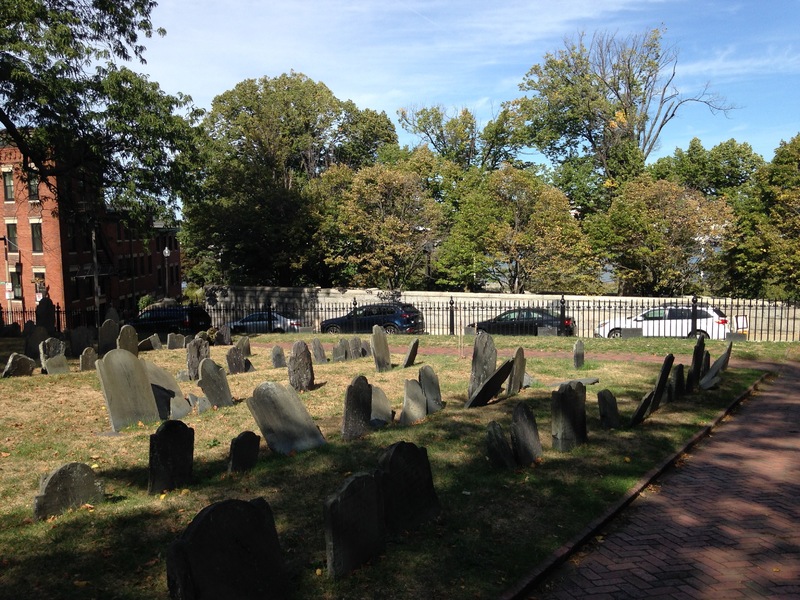
In the Boston unit, I covered Copp’s Hill Burying Ground, a small cemetery founded in Boston’s North End during the colonial period.[1] I want to argue that Copp’s Hill Burying Ground constitutes what Nora considers to be a more traditional form of memory site. Nora suggests that the traditional form of memory site represents “the remnants of experience still lived in the warmth of tradition, in the silence of custom, in the repetition of the ancestral” (p. 7). In Copp’s Hill, we’re offered such humble, warm ceremony. It represents one of the oldest forms of memorialization, the ritual of burial and the commemoration of death – which is necessarily an ancestral process. The tombstones are small and in uniform style. They are all in various states of disarray, most crumbling, many pushed over at angles, looking as if threatened to fall at a moment’s notice.
Nora argues further that memory’s is essentially “affective and magical” and “installs remembrance within in the sacred” (p. 8, 9). He believes that one of the most significant features of the historical mode of understanding the temporality is a secularization of the past and of information. Perhaps what makes Copp’s Hill seem like a traditional memory site is its religious form. It creates a narrative of its place through a fundamentally different relationship to facticity.
Perhaps here it’s important to note time period of the site’s founding. We should find that, indeed, it would be unlikely for Copp’s Hill to carry a historical narrative rather than a memorial narrative because it preceded the instinct to history, which is a modern development. Yet, at the site, we see Copp’s Hill assailed by the pressures of an historical understanding. It has been included in the Freedom Trail, a popular collection of Boston’s historical sites, accompanied by a built in walking tour that is often lead by guides. In Boston’s attempt to contextualize the site in the larger narrative of Boston’s past, we find a modern attempt to bring its story under the auspices of history. However, visiting the cemetery itself and taking its expression at face value, it’s difficult to not see it as a warm, traditional memorial site.
[1] The information presented here about Copp’s Hill Burying Ground was gathered by a personal visit of this author to the site, explaining its lack of secondary citation