Moscow: Poklonnaya Hill
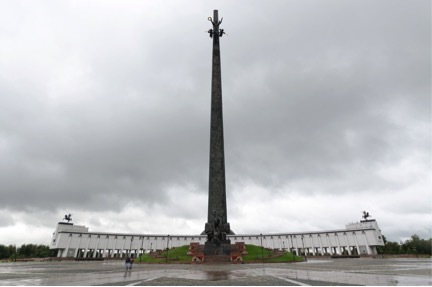
In the Moscow unit, I covered different commemorations across the city of the Patriotic War of 1812.[1] Here, I want to argue that one such commemoration, Poklonnaya Hill, represents the perfect example of the historical mode of the lieu de memoire from Nora’s perspective. Nora asserts that the historical impulse to the past comes to us at “panoramic distance” and creates “definitive estrangement” (p. 18). He insists that its tenor is “spectacular and triumphant, imposing and, generally, imposed” (p. 23). What we’re given in Poklonnaya Hill is nothing if not panoramic and estranging, spectacular and triumphant. Its massive monuments, highlighted by a 141.8-meter tall obelisk, make the person small, insignificant relative to size of expression. Its park is vast and, seemingly, there is little for the individual to engage with in a human scale. “Whatever vitality [it] retains”, as Nora contends about the historical mode, “impresses us only in [its] spectacular symbols” (p. 12). Poklonnaya Hill gives us a clinical approach to the past that attempts to valorize its narrative.
It bears mentioning that the site carries some traditional memorial information. It was the place where, during the Napoleonic Army’s failed capture of Moscow in 1812, Napoleon waited to receive the keys to the Kremlin, never to actually obtain them. However, much of the sites construction, in its current incarnation, occurred in the 1960s under Soviet regimes, attempting to spark a new relationship to the past under the auspices of a historical mode. This fact points to Nora’s notion of the historical relationship to the past as “integrated, dictatorial memory – unself-conscious, commanding, all-powerful, spontaneously actualizing memory without a past that ceaselessly reinvents tradition, linking the history of its ancestors to the undifferentiated time of heroes, origins, and myth” (p. 8). Poklonnaya Hill, in this vein, is an authoritative project to recapitulate the past. Perhaps there is no better example of this than the case of the Triumphal Arch of Moscow, which was constructed in the 19th century to commemorate the victory and was rebuilt at Poklonnaya Hill in 60s. In the Triumphal Arch, we see this attempt of Nora’s understanding of historical know to reinvent history and link it it to a new understanding of heroism. Generally, Poklonnaya Hill demonstrates many of the fears of historical knowing that Nora offers us, but we might be wont to disregard without such embodiment.
[1] Information on Poklonnaya Hill from Murrell, Berton Kathleen, et al. “Moscow – Cultural Life.” Encyclopedia Britannica. 2016. Online.
Wikipedia contributors. "Poklonnaya Hill." Wikipedia, The Free Encyclopedia. Wikipedia, The Free Encyclopedia, 11 Dec. 2016. Web. 11 Dec. 2016.