A Diverse Community
The West End Museum proudly reflects upon the diversity of the old West End’s neighbourhood. Marking a layer of the cultural palimpsest we can now observe in retrospect, an entire wall of the museum is dedicated to the diversity of the population: A Citizen Class Roster has records that enable us to identify the multitude of ethnic backgrounds that sought residence in the West End. The Museum compares the West End itself with the bustling North End of first half of the 20th Century, and explains that many immigrant families moved out of the North End and into the West End due to over cramping in the former.

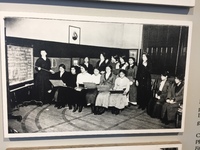

Furthermore, the Museum draws our attention to the diversity of the neighbourhood in presenting the literature that was propagated throughout the area. The Handbill, printed in four different languages, points to large Irish and Eastern European settlements. The existence of all these communities in the same area is indicative of the West End as a less wealthy, but welcoming, varied area. The co-existence of each community suggests that the population here were more concerned by the need to get on with their lives than to claim an advantage over another community of people – a point that is also emphasized by the Museum.

Other sources can confirm this overarching sense of community derived from an assortment of backgrounds. Sammarco, in his book dedicated to the West End of Boston, claims that the West End ‘became home to successive waves of immigrant groups and native Americans whose cultures and traditions enhanced the definition of a “West Ender”’[4], which implies that these immigrant groups improved the sense of community in the area, supporting the view the Museum presented of the neighbourhood. Moreover, the identity of each individual immigrant, as an equal, contributed to the sense of identity of the entire neighbourhood, which adds to the idea of a dense, varied centre.
Taking these views of the community into account corroborates the views of Sennett and Arendt: the dense, anonymity of the West End allowed for immigrants, all on equal footing as they came to the West End with little to nothing, to interact and form a collective that represented something greater than just their own communities. The West End, in accordance with Sennett, became an ideal example of the public realm, in that it was a haven in which many could find a home, and so the inhabitants became part of something greater than the communities they each identified with.
[4] Boston’s West End, Sammarco, Anthony M., Arcadia Publishing, 1998
Taking these views of the community into account corroborates the views of Sennett and Arendt: the dense, anonymity of the West End allowed for immigrants, all on equal footing as they came to the West End with little to nothing, to interact and form a collective that represented something greater than just their own communities. The West End, in accordance with Sennett, became an ideal example of the public realm, in that it was a haven in which many could find a home, and so the inhabitants became part of something greater than the communities they each identified with.
[4] Boston’s West End, Sammarco, Anthony M., Arcadia Publishing, 1998