Mega Moscow
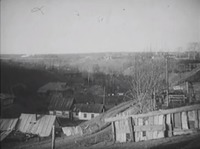
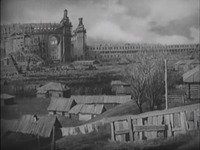
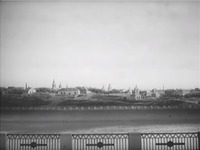
Moscow of the late 1930s is another city that is heavily tainted with subjectivity. Russia was under rule by authoritarian dictator Stalin who ushered in a transformative era for the all of Russia and Moscow in particular. Moscow was to be the crowning center of Stalin’s Soviet Empire, and so was undergoing a massive reconstruction phase. The film New Moscow captures the city during this transition phase and depicts many of the cultural struggles this forced change brought about. A character in the narrative is a painter who comically becomes aggravated when buildings he is attempting to capture are demolished. Yet, his character brings to light a concern played throughout the film’s plot: the disappearance of the old Moscow. Another more obvious example of this can be seen when the main character gaffs by presenting a film about Moscow’s exciting construction plans in reverse and showing the reversion of all the progress. The audience’s response to this is laughter reflecting the notion that returning to a simpler past is laughable.
______________________________________________________________________________
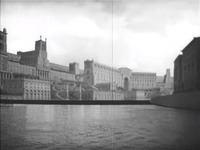
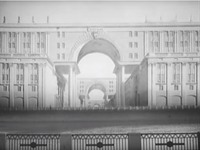
The history of the film’s production and release also further defines the captured Moscow. Originally, the film was set to release in 1939 but was banned due to Soviet censorship policies. This implies that the film’s satire was extreme enough to be found too offensive to the authoritarian regime revealing a dismal tone on the state of artistic creativity throughout the city. The action of censorship also highlights which subjective ideas the government was imposing on its citizen’s perception of the public realm. Strong nationalistic concepts found throughout the film show that imposition in action working to only further perpetuate that impression of Moscow. Mocking progress is banned in Moscow showing how progress was everything to the Stalin regime. That tone can be derived from the many grandiose construction projects Medvedkin's portrayal of Moscow’s General Plan show.
______________________________________________________________________________
______________________________________________________________________________
Yet, the ideal envisioned city never came to fruition. The stark contrast between the current Moscow and the proposed Moscow are two entirely different things. While history shows that the Stalin regime eventually loses, Stalinist Russia disappears alongside leading to the conclusion that the envisioned Moscow was definitely a product of Stalin and not of the people. Had the people’s desires been the foundation the public realm could have been sustained.