Introduction
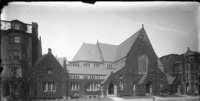
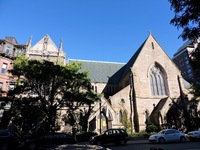
Emmanuel Episcopal Church, located at 15 Newbury Street, is a relic of early Back Bay with its Gothic-Revival architecture, grandious stain-glass, and weekly Bach Cantatas. Despite its sense of longing for the past, Emmanuel Church has been and remains a vibrant center for prayer, learning, music, social-justice, and more. When I went by to explore, not only was I welcomed in, but I was given a grand tour full of singing and story-telling. Along the way I sat in on a group discussing 'Black Lives Matter' alongside a youth choir singing modern songs all within the confines of this 19th century church. Michel De Certeau, in his book The Practice of Everyday Life, describes a city as "a patchwork quilt of individual view points and opinions" and yet, Emmanuel Church stands as a historic sympol of Boston's diverse opinions coming together. As I explored the buildings hidden crevices and heard its most interesting myths, the decades of traditions seemed to build on one another, giving insights to the evolution of this, still lively, progressive Christian epicenter.


“People moving through the city at ground level write the 'urban text' without beingable to read it. The city is provisionally created as a patchwork quilt of individual view points and opinions. The created order is everywhere punched and torn openby ellipses, drifts, and leaks of meaning: it is a sieve-order.'"
- Michel De Certeau, The Practice of Everyday Life

The churches liveliness is only matched by its history of social justice and it's appreciation for the arts. The artistic appreciation at Emmanuel Church started with its original designer, Alexander Rice Esty, who is one of New England's most prominent architects and the foremost expert in Gothic revival, having built over 20 churches in the style (including 2 in Cambridge). Since Esty, the church has expanded and evolved but only ever by the hands of great artists, such as Frederic Crowninshield and Ninian Comper. Thus, creating an architectural palimpsest that allows onlookers to experience some of Boston's finest craftsmen and artists from the past 150 years. Besides the physical beauty of the church, the love for artistry continues in book clubs, crafts classes, and most notably, Emmanuel Church's extensive musical programming.


In terms of social justice activity, there are few organizations in Boston more historically active than Emmanuel church. Most known for the Emmanuel Movement, a very progressive move in 1906 to de-emphasize religious practices and re-emphasize the therapuetic or spiritual nature of Christianity, was influential nationwide for its success in treating alcoholism. The church continues such forward-thinking ideologies still today, visible recently in their very active presence in Boston's Black Lives Matter movement. Along with that, the church was one of the first to have an interfaith partnership, one that continues today between Emmanuel and the Jewish Central Reform Temple. Emmanuel Church, as a center for social justice in Boston, seems to push back on De Certeau's notion that the city is "punched and torn" by individuals acting in conflict. While one can get caught up in the beauty and history of this church, when I asked the churchgoers, "what is one thing you would like people to know about Emmanuel Church?" Every single one of them answered that the lifeblood of the church is how much they care about the people of Boston. If nothing else, Emmanuel Church has and continues to take on an integral role in bringing the people of Boston together in order to write a better 'urban text' for all.