Berlin: Anonymity and Technology
During our study of Berlin, we looked at Walter Ruttman's "Berlin: Symphony of a great city," a film that cuts together footage of the city as seen from below. In black and white, the film captures clips of the city from the ground and as viewed from above, its people, its architecture, and its machinery. Without characters or plot, its aim is to capture the essence of a city, to provide a perspective on the way people move about the cities physical fixtures to create a landscape that could not exist in their absence (1). The film's style of capturing people from a distance, in a flash, never to be seen again, provides a window into the feeling of anonymity that exists within a city where people move past more and more quickly in automated vehicles through a world that is more and more willing to rely on indistinguishable pieces of automated metal than individuals and fellow Berlin-dwellers.
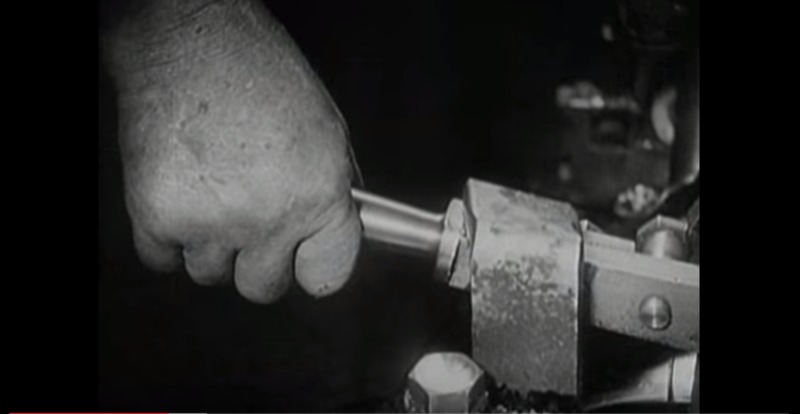
Interestingly, a large portion of the film is devoted to capturing the machinery at work in the industry centers of Berlin in 1927: cogs turning, wheels moving (as pictured to the left) and entire factories starting at work without a soul to see. Through my blog post on this urban text, I was able to tease out a relationship between the feeling of anonymity, of alienation and unrecognizability toward others within the same space, and technological advance during this period of industrialization in Berlin. Parsing the shot (pictured to the left) of a hand pushing down on a lever to activate a set of factory machinery, I argued that the film provided an avenue for understanding some of the advantages and drawbacks of the kind of anonymity that comes with increased automation (1). Does technology enhance humanity, strengthening our means for individual expression, or does it mechanize us the process? To what extent is the lever an extension of the hand, a virtual prosthesis? Embedded in this representation of Berlin is the anxiety that technology will lead to our mechanization and subsequent uniformity, conformity and alienation rather than expression and acceptance as Hannah Arendt initially predicted.
1. Berlin: The Symphony of a Great City. Dir. Walter Ruttman. Youtube. Youtube, 2 Dec. 2011. Web. 9 Dec. 2016.