Boston: Anonymity and Sanitization of the Monied World
During our Boston unit, I explored the way in which The Friends of Eddie Coyle reflected imagistically Engels' idea of the city whose landscape is determined, divided up, and sectioned off in ways that sanitizes the city as it consumed from the upper-middle class point of view: “This arises chiefly from the fact, that by unconscious tacit agreement, as well as with outspoken conscious determination, the working-people’s quarters are sharply separated from the sections of the city reserved for the middle class” (1). In the film, we saw how suburbia created a seemingly sanitized version of reality for the upper-middle class, until the thieving mob underworld penetrated its idyllic vision (2). The sanitized world turns out to be a delusion, a continued act of repression of the darker parts of the city, and one whose anxiety permeates the idyllic suburban shell.
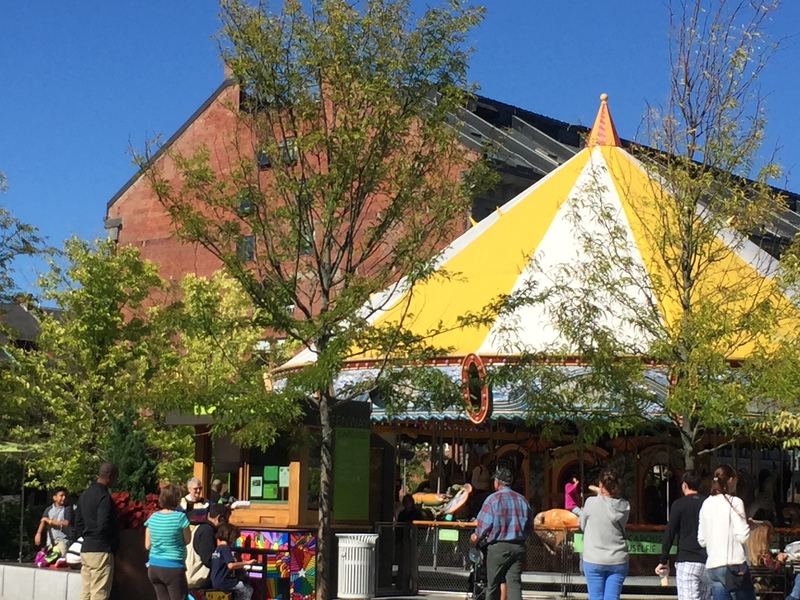
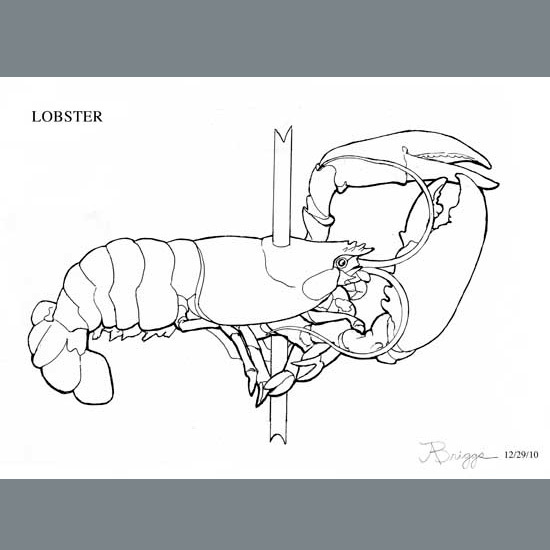
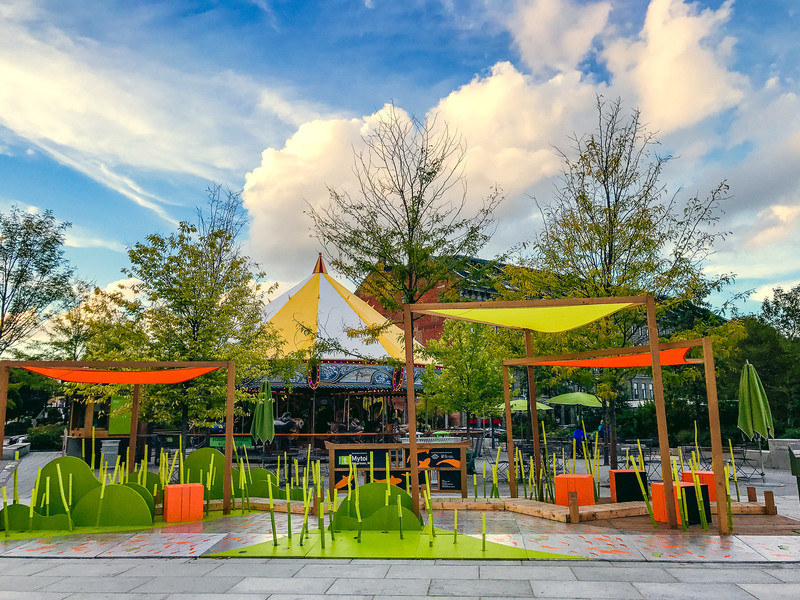
Perhaps the Greenway Carousel represents a physical manifestation of that santization anxiously portrayed in The Friends of Eddie Coyle. The Carousel itself was designed as a miniature utopia, a place that is welcoming to all kinds of people as well as safe and beautiful for kids. From its wholesome folk music to its colorful animal seats, whose designer told the Boston Globe that “[I’ve seen] as many smiles as you can imagine," the carousel represents a miniature utopia/dystopia on the Greenway, a small sanitized world funded by corporate interests, and situated within a larger, more complicated hidden context (3). The Mytoi garden art exhibit, situated around the outside of the carousel is a plastic representation of a Mytoi garden, meant to be a place of serentiy and peace. This miniature plastic garden, in my opinion, provides poingant commentary on the artificiality of the constructed utopia and its insufficiencies as place for true serenity (4). The entire area impacted by the "Big Dig" Boston megaproject to move the central Boston highway and place in its old location the Rose Kennedy Greenway represents an urban "cleanup," or an attempt to re-envision the city in a specific, beautified, sterilized way.
One might argue that the ability to effectively sanitize the world of the wealthy comes from the anonymity of numbers, from the collection and congregation in one place to create not only a critical mass of like-minded people between whom exists such a "tacit agreement," but also a degree of anonymity that allows them to shed individual culpability.
1. Engels, Friedrich, and Florence Kelley Wischnewetzky. "The Great Towns." The Condition of the Working-Class in England in 1844 (n.d.): 23-74. Web.
2. The Friends of Eddie Coyle. Dir. Peter Yates. Perf. Robert Mitchum and Peter Boyle. Paramount Pictures, 1973. Daily Motion. Web. 9 Dec. 2016. <http://www.dailymotion.com/video/x2apnkt_the-friends-of-eddie-coyle_shortfilms>.
3. Lotan, Gal Tziperman. "Riders Take Greenway Carousel for Its First Spin - The Boston Globe." BostonGlobe.com. N.p., 01 Sept. 2013. Web. 09 Dec. 2016. <https://www.bostonglobe.com/metro/2013/08/31/riders-take-greenway-carousel-for-its-first-spin/fEW0KaXorcGxCoieqFOUSJ/story.html>.
4. Conti, Matt. "Japanese-Inspired Garden, Mytoi, Pops Up on Greenway - NorthEndWaterfront.com." NorthEndWaterfront.com. N.p., 30 Sept. 2016. Web. 09 Dec. 2016. <http://northendwaterfront.com/2016/09/japanese-inspired-garden-mytoi-pops-greenway/>.