[District as palimpsest] The North End
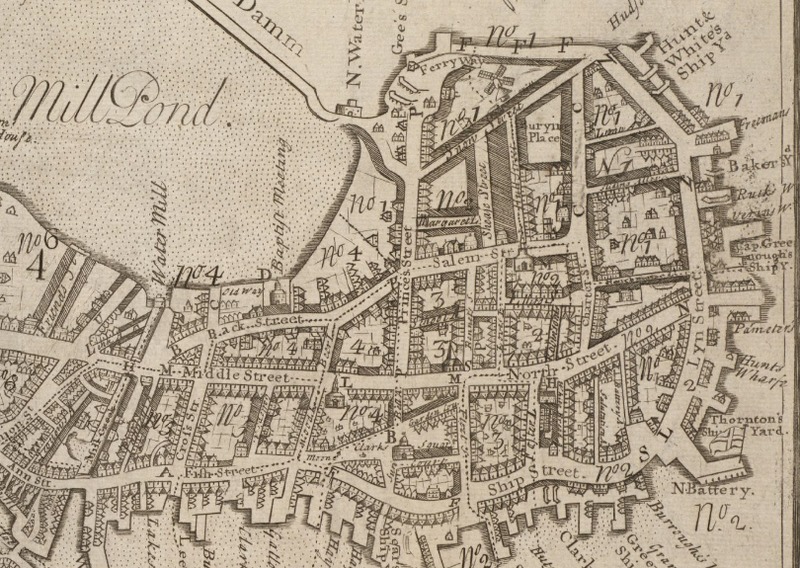
Located in the northernmost point of the Shawmut peninsula and settled since the 1630s, the North End is Boston's oldest residential community[1]. This neighborhood has experienced significant changes across its almost four centuries of existence, being home to some of the most important historical moments in the city of Boston.
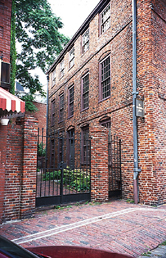
In the early 17th century, the first inhabitants of the North End were merchants attracted by the waterfront, which quickly became a center of shipping and trade[2]. These early residents built their houses around North Square, where the Paul Revere House, built around 1680, is located. Unlike what we see today, most of these early buildings were made of wood, but a series of fires motivated the transition to red bricks. During the 18th century, the North End became the most popular residential hub in Boston among wealthy families, who erected grand red-bricked, Georgian style houses around the area. Only a couple of these buildings remain today, notably the Pierce-Hichborn House (circa 1711) in North Square and the Christ Church (1723), later known as Old North Church, which is said to be the place where Paul Revere hung two lanterns in 1775 to warn the patriots in Charlestown about the movements of the British army, during the American Revolution.
The North End saw an important demographic change after the Revolution and across the 19th century. The neighborhood became dominated mostly by small merchants and artisans, as the wealthy merchants left the North End for new blooming residential areas. Many of the large houses were put for rent or simply demolished to build row housing. The booming shipping and mercantile trade gave rise to many entertainment establishments in the waterfront district, including taverns and dance halls. But the 19th century North End was mostly marked by a series of immigration waves, which went on to shape the neighborhood’s rich cultural heritage. First came the Irish, following the serious potato famine that struck Ireland in the 1840s, and who ended up making up half of the North End population by 1855. The 1870s saw large immigration waves of Polish and Russian Jews, and almost simultaneously, a vast Italian immigration commenced, making the North End population 90% Italian by the 1920s, and having a lasting impact on this neighborhood’s identity as Little Italy.


The 20th century North End was marked by major construction projects in the area, having an important impact on the neighborhood’s aspect. Some of these projects include the Summer and Callahan tunnels in the 1930s and 1960s, and most notably, the elevated Central Artery in the 1950s that separated the North End from the rest of Boston, to be later replaced by an underground highway during the Big Dig project in the late 20th century.
With its immense historical and cultural heritage, it is no wonder that the North End remains a popular attraction among locals and visitors. This neighborhood represents a rich cultural palimpsest, a continuously evolving canvas that has managed to preserve elements across its four centuries of existence, from the earliest wood and redbrick houses that are now open to the public as museums, to the Italian restaurants, bakeries and cafes, to the transportation projects that have altered its appearance and connection to the rest of Boston. The character of the North End has been continuously influenced by its different sets of inhabitants, from the early merchants, to the prominent patriots that inhabited it, to the vibrant Italian immigrant community. At the same time, these changes in the character of the neighborhood have influenced the makeup of the North End community, as reflected by the currently increasing number of young professionals moving to the neighborhood, attracted by its sense of community, good culinary offer, and convenient location.
The rich historical and cultural heritage of the North End call for a more refined analysis of the elements that comprise it, and that have had a crucial role in shaping its identity as cultural palimpsest. In the next sections of this exhibition I focus on the study of the Paul Revere House located in North Square, and the life of Paul Revere.
[1] Boston Redevelopment Authority website, North End page http://www.bostonredevelopmentauthority.org/neighborhoods/north-end/at-a-glance
[2] Boston Landmarks Commission (1995). "North End Exploring Boston's Neighborhoods" (PDF). Retrieved September 27, 2015.