[Individual as palimpsest] Paul Revere
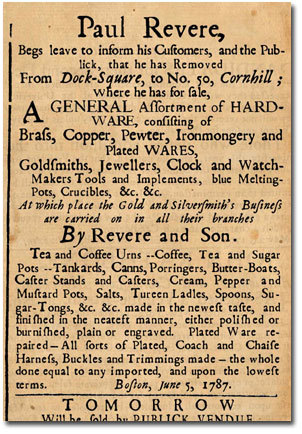
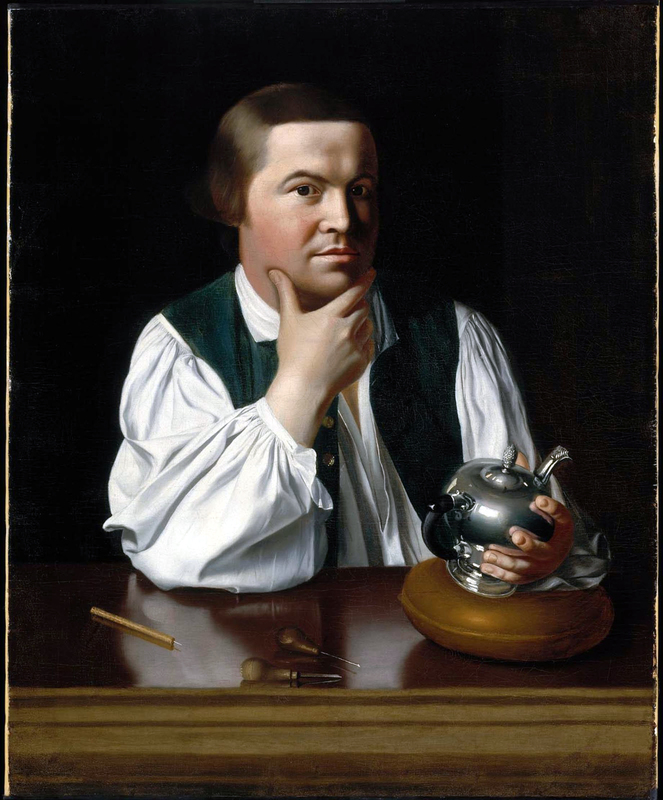

The concept of the cultural palimpsest extends beyond districts and landmarks, and into the very individuals that inhabit the city. One of the most striking facts about Paul Revere, the famous patriot in the American Revolution, is that he did not become famous until after Henry Wadsworth Longfellow published his now well-known poem “Paul Revere’s Ride” in 1860, almost forty years after Revere’s death. Beyond the brave activities that eventually led him to fame, Revere was not just the messenger who warned the patriots of the movements of the British troops, and in fact developed a series of a myriad of activities during his lifetime.
Revere the goldsmith
Paul Revere was born in 1734 in a modest family from the North End. His father was a goldsmith (or silversmith) who migrated from France at a young age, and his mother descended from several New England artisan and land-owning families. Paul apprenticed with his father as a goldsmith and took over the shop in 1756, after conducting military service during the French and Indian War. He became the proprietor of a large shop with apprentices and journeyman employees, and his customers included wealthy Boston inhabitants, as well as his neighbors, relatives and political associates.
Revere produced items in both gold and silver, though most of his preserved pieces are of the latter product, including elegant spoons and creamers, currently on display in the Revere House. As an additional source of income, Revere also produced copperplate engravings including bookplates, mastheads, and illustrations for magazines.
Revere the revolutionary
In addition to his silversmith work, Paul Revere acted as a main spokesman for Boston middle class artisans and laborers during the Revolution. He knew many of Boston’s radical leaders due to his connections as an active Freemason and through his wealthy customers. In the 1760s he joined several of underground political clubs in Boston, including the North Caucus, allegedly responsible for the organization of the Boston Tea Party. In 1774 and 1775, Revere served as paid courier for the Committee of Safety. The night of April 18, 1775, Revere left Boston by horse to warn the patriots in Lexington of the British troops’ movements, which would be later known as the "Midnight Ride to Lexington". He went on to serve as an officer in the Massachusetts militia from 1776 to 1779, during which he commanded a fort in Boston harbor and took part in several expeditions, including the Penobscot expedition, one of the most disastrous campaigns of the American Revolutionary War. Revere was accused of cowardice and insubordination, and subsequently dismissed from the militia. A few years and several attempts later, Revere was finally able to get exonerated of these charges by a court-martial.
Revere the businessman
After ceasing his active participation in the Revolution, Revere started a series of ventures that rapidly increased his personal income, including a hardware store, a foundry, and a copper-rolling mill. The hardware store operated at a series of locations in Boston in the 1780s, where he sold locally-made and imported goods, as well as items made in his goldsmith shop. In 1788, Revere opened a foundry on the North End waterfront, where he cast cannons and bells. In 1801, he established the first successful copper-rolling mill in North America. Among other things, Revere’s copper was used to cover the dome of the Massachusetts State House on Beacon Hill.
With his manifold different activities throughout his life, Paul Revere illustrates the concept of the cultural palimpsest taken to the individual level. Cities and its different elements are constantly shaped by the individuals that inhabit them. Individuals themselves are in turn influenced by their historical and cultural contexts, thus creating an endless cycle of reinventive forces that shape the present and give rise to the future. As suggested by his business enterprises, political and military involvement in the American Revolution, and even his persistence in clearing his name, Paul Revere was an individual capable of overcoming challenges and of successfully adapting to changing circumstances. His actions went on to influence his environment as much as his daily activities were influenced by the times in which he had to live. The constantly evolving product of these interacting forces are individuals like Revere, landmarks like the Revere House, districts like the North End, cities like Boston, multiple layers of cultural palimpsests that speak of the past as much as they provide perspectives for the future.

