[Landmark as palimpsest] The Revere House
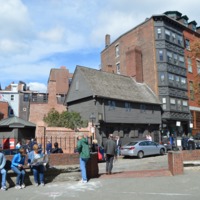
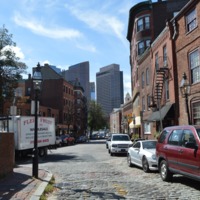
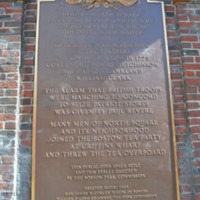
Built around 1680, the Paul Revere House is the oldest house in downtown Boston, and is located in 19 North Square, in what used to be the heart of the North End in the 17th century. Paul Revere, then a silversmith, bought this large Colonial house in 1770 and moved in with his wife, his then five children (he went on to have 16 between his two marriages), and his mother.[1]
During my visit I learned that, just like the neighborhood in which it is located, this house has undergone a series of changes in terms of its inhabitants, appearance and uses since it was first built. The first owner of the house was a wealthy merchant called Robert Howard, who lived there with his wife, his daughter, and his slave. In the 1740 and 50s, the house was owned by the Knox, a family of artisans and mariners. Due to financial problems, Andrew Knox lost his house to John Erving, a real estate speculator, in 1763. Erving, in turn, sold the house to Paul Revere in 1770. Revere and his family owned the house until 1800, even though it is believed that they did not live there for most of the 1780s, when they would have put the house for rent due to financial pressures. After the Revere family left, the building was used as a boarding house for transient seamen, while the ground floor was used as shops, including a candy store, a cigar factory, a bank and a vegetable and fruit business at different times. In the 19th century, the house was home to various immigrant families.
As the building started to deteriorate towards the beginning of the 20th century, Paul Revere’s great-grandson, John P. Reynolds Jr., bought the house in 1902 to prevent demolition. The Paul Revere Memorial Association was then formed to organize the renovation efforts, led by prominent architect Joseph Chandler. The house was returned to its 17th century appearance, and opened its doors to the public in 1908, constituting one of the first historic house-museums in the country. Ninety percent of the structure, two doors, three window frames, and portions of the flooring, foundation, inner wall material and raftering, are original. The house currently displays two floors (a third floor was added in in the mid 18th century and removed with the restoration work). The first floor contains the kitchen and the hall, a multipurpose room that in any given day could have been used as a parlor, a dining room, workshop, or business office. In the second floor there are two chambers, as well as a small display of silver items made by Paul Revere in his workshop. Some of the furniture owned by the Revere family has been preserved, although most of what is displayed in the house belonged to other families in the 17th and 18th centuries. The courtyard also displays a 900-pound bell and a small mortar made by Revere and sons.
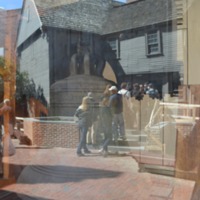
With the multiple changes experienced by this building across its over 300 years of existence, the Paul Revere House represents a cultural palimpsest of its own. This house has seen its purpose constantly reinvented so as to fit the needs of the particular historical and cultural contexts it has witnessed, from being home to rich merchant families, to hosting transient sailors and immigrant families, to operating shops of various natures, to finally becoming a historical attraction. The series of structural changes it has endured in time, including its incredible renovation at the beginning of the 20th century, also reflects a sense of resilience and adaptation to changing times. Standing in front of the Paul Revere House in our current times represents a truly striking experience, an incredible contrast between the preservation of the simplicity of the colonial past and the modern present, filled with tourists, their modern cameras, and their bright-colored clothes.
Video recording the outside view of the Paul Revere House in North Square during my visit. Particularly striking is the contrast between the 17th century looking house and the crowd of tourists taking photographs.
[1] The Paul Revere House website. https://www.paulreverehouse.org/