Control through Colonialism
“Colonialism, as a political, economic, and cultural process, was the vehicle by which urban planning was exported to many non-Western societies... In the simplest analysis, colonialism was a means by which the metropolitan power extended its markets for manufactured goods and by which the colonies in turn, supplied raw materials to the metropolis.”
– [1] Anthony D. King in “Urbanism, Colonialism, and the World-economy (367)
The original colonial power in Bombay was the Portuguese who were the most advanced seafarers during their time. In 1534, Portuguese captured these islands to create trading centers, calling the area “the good bay” (Bom Baim or Bom Bahia). The trading with local people included silk, muslin, chintz, onyx, rice, cotton, and tobacco [2]. By the early 1600s, the islands was developed by the colonists who set up a great warehouse, a frairy, a fort, a shipbuilding yard, new houses for the population, and mansions for the wealth, all of which is evidence that “colonialism… was the vehicle [for] urban planning” [2,1]. In 1665, Charles II of Britain took possession of the islands as part of dowry and in 1668, Charles II started renting Bombay to the English East India Company for an annual rent of a paltry ten euros (equivalent to 1,226 euros in 2008) [3]. The Company soon after developed much of the island for trade and as a port city.
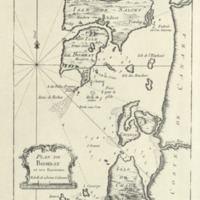
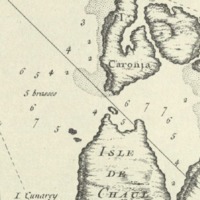
The author and audience in relation to the map also show the control of the colonialism: this map was made by a navigator and for future navigators. Numbers are scattered around the sea, which relay the information of depths most likely in leagues as mentioned in the legend. The depths are not found everywhere there is sea, but in a pattern that suggests that the creator and future sailors can and should sail to every island. The sailor does suggest to visit other islands even though the focus on this map is on the “Isle de Bombay” as it is both in the center of the map, has the most pictorial detail, and also is in the title “Plan de Bombay et ses Enviors” (the map of Bombay and the its surroundings).
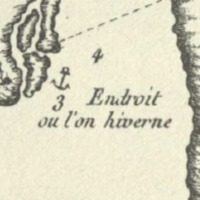
Not only is there information about depths for future sailors, but there is also a note telling navigators where to winter! This map is not just a geo-spatial representation of the space, but also a message and advice for future travelers. In the southwest corner of the “Ile De Salcet,” there is a symbol of an anchor, which may suggest a safe space to anchor, and the words “Endroit ou l’on hiverne” (place where one winters) suggests the area can be visited in winter.
These small details on the map show the motivation of the mapmaker and future audiences. It is evidence that not even just the British but the French wanted to explore this area. The creation date of the map is 1764, only one year after the Seven Years War, which was a war fought mainly between the French and the English (but included every great European power except the Ottoman Empire) for balance of power and control of much of the colonialized lands. The map shows the exertion of European power - not just the French and English, but potentially other navigators from other countries. Moreover, the reverse but relevant point should be noted: the map, in turn, enforces the exertion of European powers. Future sailors will be using this map to further gain control of the region.
Resources:
[1] King, Anthony D. “Urbanism, Colonialism, and the World-economy.” The Blackwell Reader. (2010) Page 367.
[2] Bombay: History of a City. (2006).
[3] Da Cunha, J. Gerson. Origin of Bombay, Asian Educational Services. (1993)