Control through Cartography
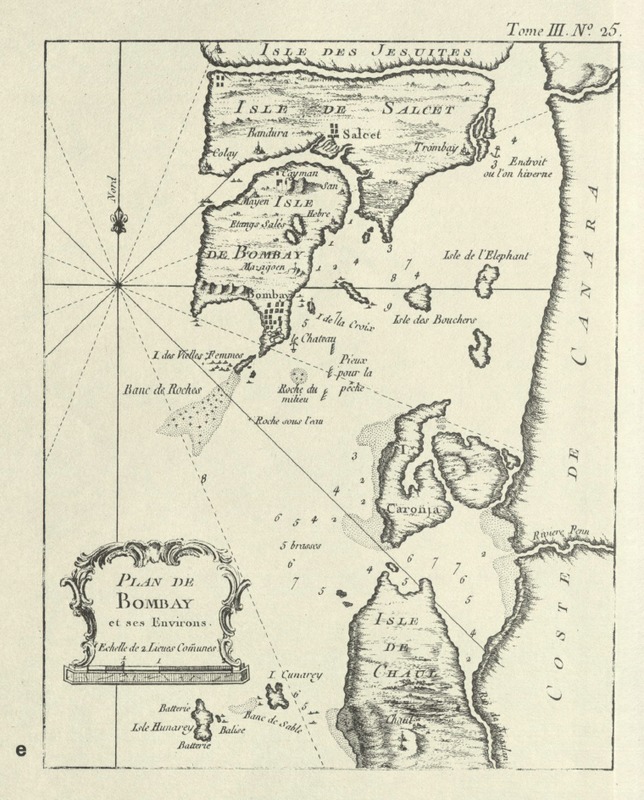
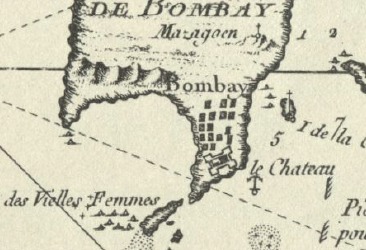
By drawing and labeling the physical space, the cartographers of the time are imposing their understanding of the space. Outside of Europe, India was the most mapped place at the time [1], evidence for the British and European economic and political interest in controlling the country. We see evidence of the European influence and rule throughout the map.
First, the language the map was made in and the names used show that there is heavy European influence. Without knowing that this is a map of several islands are in India, it would almost be hard to tell that the map was of Indian lands. Everything is in French (chateau, isles, etc.); islands are named with references to religion as the top most island is called “Isle Des Jesuites” in a time when the Jesuits did not have much influence in India. Even so, the island shows a discrepancy from the naming of other maps (above the island of Bombay is the island of Mazagaon). The name of the “Isle de l’Elephant” like the name “Bombay” was taken from the Portuguese naming (Elephanta Island named by Portguese explorers after seeing a sculpture of an elephant when landing, Bombaim, respectively) [2].
Second, the amount of detail of the waters in comparison to the land and also the detail of in the larger scale version shows how these maps were not for control of the internal lands yet. The first step was to gain control of and navigate the waters safely in order to trade or move inland. We can see that only a few landmarks were drawn pictorially and only on the island of Bombay suggesting the navigator did not go onto other islands or did not think the landmarks were important. There seem to be small drawings of settlements and lakes on the island of Bombay and more labels. The other islands have some shading to suggest contour. The larger map of the coast of Concan and Decan, the other map Bellin drew, is not shown to have any detail of the sea, but rather place the cities in context and distance from each other, the coast, and some suggested mountain ranges.
Third, we could compare this map with a map drawn in the same time period, but by a man who did not travel to the area: Thomas Kitchin drew the two maps: “A Map of the Countries round Surat and Bombay” and “A new and accurate Map of Bengal”) in 1783. It is a little presumptuous to call the map “new and accurate” though many of his maps were apparently called so since Kitchin frequently just used maps drawn by others to create his own. Kitchin was a prolific mapmaker, engraver, and publisher [1]. It is a bit difficult to really test the discrepancies of these maps as the scopes are very different. What is interesting is the level of detail in the second map despite never traveling to the area, which suggests how much imagination and use of previous maps there can be. It seems dangerous that there is this self-referential information in mapmaking and understanding of the lands and its peoples. There was a concerted effort by the government, the military, the military, and the traders to understand the space in order to be able to exert control over the resources, which would a counter trend to producing incorrect maps.
In addition, to the map by Kitchin, there is a map published on an article in the Guardian that looks eerily similar to Cap. Bellin’s map. It is the same map except turned on its side (with all the words in a different orientation than Cap. Bellin's map). We can see how easy it is for another mapmaker to recreate the lands from another map – furthering the worry about how maps represent the reality of space and how self-referential and closed the system map mapping was at the time [3]. Not only is there a worry of discrepancies, but there are actual discrepancies in the naming of the islands: as most sources name original seven islands: “Isle of Bombay, Colaba, Old Woman’s Island (Little Colaba), Mahim, Mazagaon, Parel, Worli”) while Bellin's maps use some different and French names [3].
Resources:
[1] Collected by Gole, Susan. (1980). A Series of Early Printed Maps of India in Facsimile. JayPints. New Delhi, India.
[2] Elephanta Caves. UNESCO. (1987)
[3] Perur, Srinath. “Stories of cities #11: the reclamation of Mumbai – from the sea, and its people?” The Guardian. Cities: The story of cities. March 30, 2016.