Overview: Reading Bombay through Maps
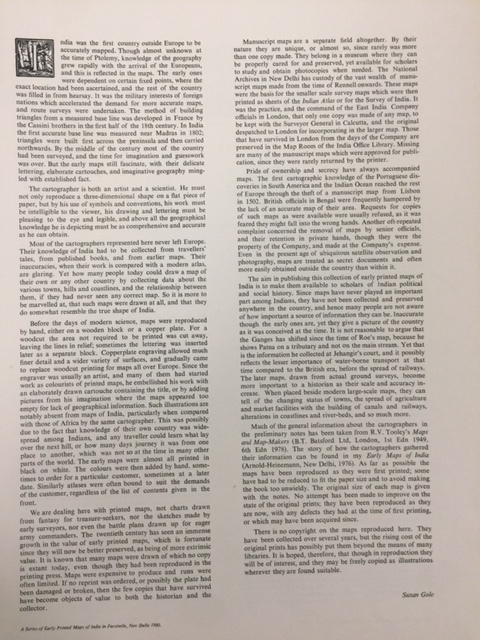
“The cartographer is both an artist and a scientist.”
- Susan Gole, “A Series of Early Printed Maps of India in Facsimile”
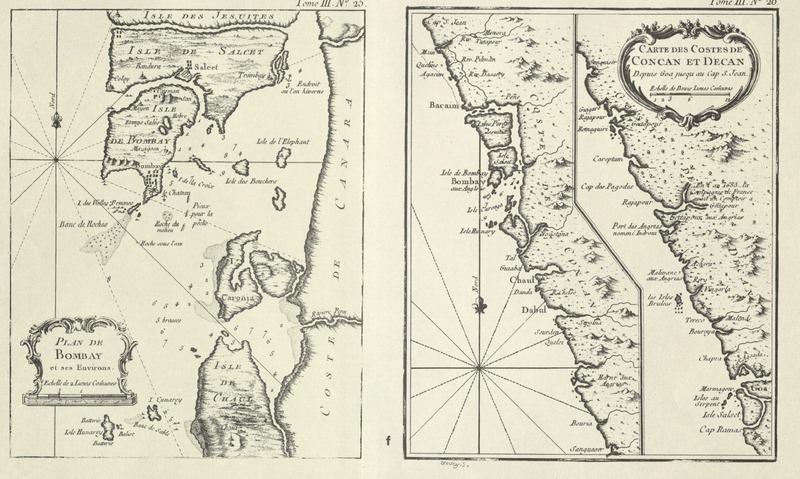
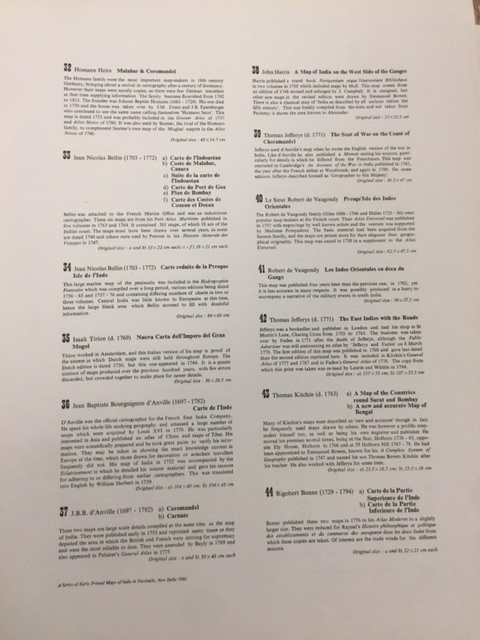
A map can be used as a piece of visual rhetoric that not only provides a geo-spatial representation of a place, but also codes information about the context, the author, and the audience. The chosen map is the one on the left titled “Plan de Bombay et ses environs.” The map was made by the French navigator Captain Jacques Nicolas Bellin (1703-1772) in 1764 and was published in 1980 in the atlas compiled by Susan Gole ("A Series of Early Printed Maps of India Facsimile"). Many of the earlier maps were dependent on observation from a fixed point and then hearsay about other parts of the space. Later, the maps became more accurate due to military interests in foreign nations. The maps in this atlas were drawn for the printing press, which would imply that many of these maps were not drawn in fancy or drawn by “eager army commanders” - the atlas, hopefully, includes the more unbiased maps of the time. However, we’ll see that the lack of information and the choices that inherently an “artist” must make shows not a completely objective picture of the space and even time. Instead, we see how heavily colonialism influenced the perception of the lands and how maps in turn spurred on more European influence, as maps like this way most likely made it easier for Europeans to come to Bombay.
Bombay (or currently named Mumbai as of 1995) was not always the city it is today: as the capital city of the state of Maharshtra, it is the most populous city in India, has the highest GDP of any city in India, and is a thriving cosmopolitan, multi-cultural city, home to the internationally-loved entertainment industry, Bollywood. Originally, Bombay was seven islands that were mostly home to fishing colonies as one can see from the map. Most of Bombay's history is one of rule by foreign powers. Initially, the islands of Bombay were under successive control of indigenousness empires before the 14th century. Mumbai was then under Muslim rule in the 14th century and the Portuguese control in the later half of the 16th and the earlier half of 17th century, which opened India up to more European powers including the Dutch, the English, and the French. This map created in during the British rule was created by a French maritime captain whose audience is for future navigators already points to the colonial history and motivation for much of the activity at these islands during the time [2].
Resources:
[1] Collected by Gole, Susan. (1980). A Series of Early Printed Maps of India in Facsimile. JayPints. New Delhi, India.