Bombay
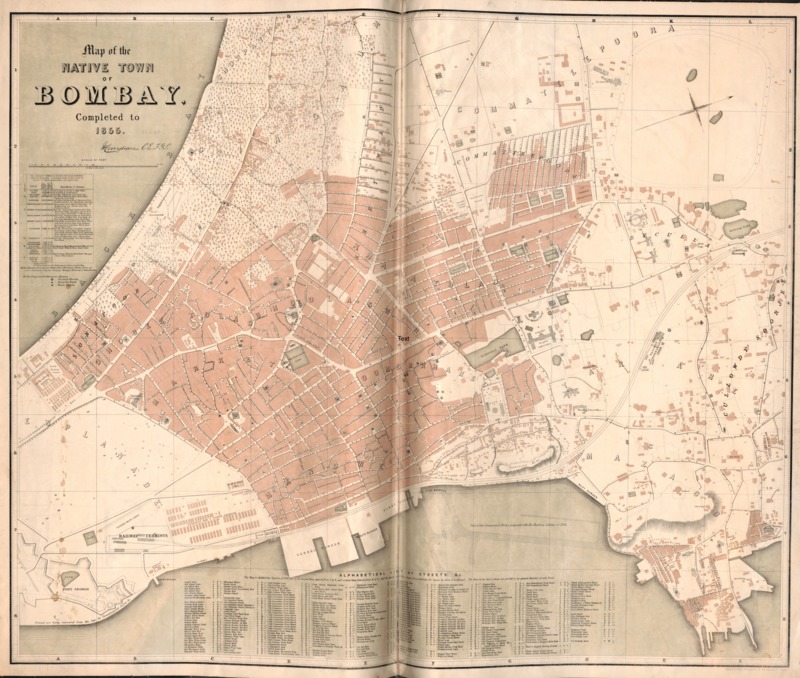
Nyambi’s latest exhibit, “What’s In a Map?” discusses the city of Bombay in the year 1855. Firstly, Nyambi’s discussion is dominated by the conclusions that can be drawn from looking into Bomaby’s cartography during that time period. With this in mind, I feel it would be most useful to assess Bombay in this same way and look for what geometry we may find in the city. As mentioned in his exhibit, the city is centered where the red coloring is dominant on the map. In the map key, the city is broken up into different sections by streets. Unlike Moscow, the city lacks any kind of geometric shape. However, this is understandable as the Bombay depicted is that of yesterday, not tomorrow. Furthermore, we can look into some of the reasons that is through Corbusier’s lens. On the bottom left corner of the map is the ‘Railway Terminus’ that hasn’t yet been put to use. Besides this, there aren’t any substantial means of transportation besides the roads that were most likely occupied by other outmoded means of transportation. An objective view of this map also shows the congestion of the Bombay’s city center. As mentioned earlier, the heavy red coloring makes this quite clear. Additionally, the heavy presence of religious centers and tanks doesn’t help the congestion either. The city’s density is also a failing factor as, per the consideration of a general objective observation, the surrounding areas of the city center are seemingly barren. With all of these factors in mind, assuming that Corbusier’s analysis is correct, it is clear as to why Bombay was literally the city of yesterday in 1855.
Bridge, Gary, and Sophie Watson. "The City of Tomorrow and Its Planning." The Blackwell City Reader. Chichester, West Sussex, U.K.: Wiley-Blackwell, 2010. 345-54. Print.