Gorbushka Market
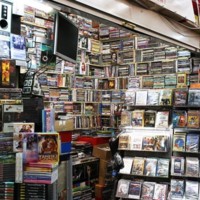
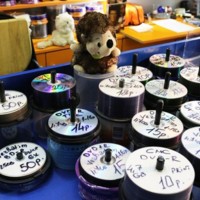
Our final stop is Moscow's Gorbushka Market near the Bagrationovskaya metro station. Gorbushka is a marketplace for all electronic goods, including DVDs, CDs, and Video Games, as well as electronic home appliances. While the market now lives in a large warehouse, its origins are in the open market tradition. The market began in the mid 80's in a park outside the Gorbanov Palace of Culture, a concert hall in West Moscow for rock concerts, live records, and festivals. At this time, Gorbushka was an open, black market for software, videos, and other electronics and a place for selling and purchasing unlicensed CD's and DVD's. In 2001, the Moscow government's attempt to close down the market was met with protests, so the government instead decided to replace the open-air market, transferring it to its current indoor site, where sales activities could be monitored. Moreover, the government, attempting to work with large manufacturers, made deals that de-incentivized black market trading.
While some black market vendors fled to other marketplaces, a thriving black market still exists under the veil of civility in Gorbushka's new location. A 2009 Financial Times article entitled "Goldmine of black market in Russian data," elucidates another dimension to the black market trades occurring in this marketplace: "If you ask them, software peddlers will show potential clients a list of 'databases'," which "consist of CDs with names such as 'Ministry of Interior - Federal Road Safety Service,' 'Tax Service' and 'Federal Anti-Narcotics Service.'" Sold for about $100 each, these CDs comprises a market of the Russian law enforcement's confidential information. Criminals, spies, and journalists alike use the information, while government officials and police officers profit from selling the information to hackers who compile and repackage it for sale online and in markets like Gorbushka. None of the information is credible, some of it outdated, some of it likely invented or tampered with, but the market for it, as well as the market for white and black market electronics, remains.
By moving the market inside, the market took on a decidedly more modern, rather than post-modern SimCity quality. The mall-style barrier between inside and outside makes the decision to enter more pointed and enhances the barrier between fiction and reality. Still, the market's physical component is not the end of the customer's interaction with the market's community. The merchandise of this market includes video, video game, and internet products that enable the buyer to enter the world of the virtual SimCity. The actual market remains a more modern SimCity, requiring its clientele to enter into its simulated world by choice. Still, its merchandise contributes to the world of the virtual, the post-modern SimCity that can be experienced at home and pervades daily life in a way that the physical marketplace cannot.
Clover, Charles. "Goldmine of Black Market in Russian Data." Financial Times. N.p., 24 Nov. 2009. Web. 29 Oct. 2016.