Tishinska Market
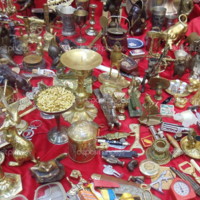

Before World War II, the Tishinska flea market was a flea market held in the Tishinskaya Square for antiques and vintage clothing. Far from a clothing store or organized indoor market, it was the quintessential large, open-space, chaotic marketplace. By the 1960s, the market had transformed into a place that drew trendy youth to its cheap prices on vintage clothing. Famously, Alexander Petlura, avant-guard fashion designer, artist and according to an article called Saint Laurent, Gaultier inspired by Russian Trash, "The World's most famous lover of 'junk,'" collected vintage accessories and rare items from the piles of stuff heaped at the Tichinska flea market. The quotations around the word "junk" in this description of Petlura capture what I believe was the spirit of the market - a place where massive amounts of seemingly insignificant pieces of "trash" or "junk" or old, used items, can be recycled into something new - where the shopper need bring imagination to his or her shopping and sift through the junk to find the gem.
Now the market has been replaced with a shopping center, and the Tichinska flea market reappears only four times per year, once for each season, and represents a haven for vintage clothes and antique lovers. As a market that appears four times a year, its impact on the city's vision of itself is slightly different and more nuanced than those markets that are fixtures of the community all year round. On the one hand, it is not part of the every-day local fiber, because it simply isn't there every day. This market remains one that you must go to, that you must approach at your own behest like the standard modern simulacrum. In fact, its four day appearance likely draws outsiders, giving it something in common with the Izmailovsky Market in its implied distance from the daily life lived by its clientele. On the other hand, its brevity creates a quarterly event, a tradition that does, by virtue of its ritual status, inform the local vision of the city. One might argue it is a SimCity that does in this way "come to you". Or, rather, the physical market does not "come to you" any more than Danilovsky and Izamilovsky, but perhaps its omission for most days of the year makes it feel more like it "comes to you" for the days when it does arrive, its traditional nature something that impacts the local culture and the self-image of the city.
ZHIKHOREVA, GALINA. "Flea Markets: Searching for Gems in Junk." Russia Beyond the Headlines. N.p., 9 Oct. 2013. Web. 29 Oct. 2016.