Sukharev Market
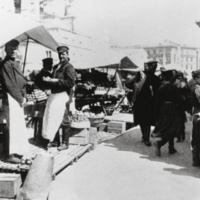
The history of Muscovite marketplaces and trade is rich and complex, and is closely tied to Russian political and economic history as a whole. Before World War II, Russia's retail trade took place in five different forms: the magaziny or large metropolitan shops which became popular in the 1870s and represented almost half of the countries retail sales; the lavki or "small shops of a traditional complexion" doing 30% of retail sales; "Treasury shops" or "franchises connected to the state liquor monopoly" doing 12% of retail sales; and outdoor trade, including fairs, markets and street vending, accounted for virtually all of remaining 8% of trade (1). Intellectuals, even in that time, thought of the open markets as vestiges of the past, representative of chaos, and soon to be eliminated and replaced, while those of country or more provincial origins felt more comfortable with this style of market than the impersonal, urban magaziny (1).
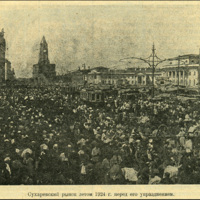
One of the most significant moments in Moscow's bazaar-style market history occurred in 1918, when the Bolsheviks imposed an anti-trade policy for "the replacement of the private trade apparatus...the closest the regime ever came to a general ban on the 'free market' or 'free sales'." Ironically, the law benefitted the wealthy, many of the most successful merchants moving into the socialist bureaucracy for the duration of the war and then transitioned back to the private sector having made important connections in the interim (1). At the same time, smaller shopkeepers and sellers moved their stores outdoors to bazaars and marketplaces in public squares multiplied. While their legal status was unclear and changing often, they were popular and essential to trade in Russia and Moscow. Suhkarev, a popular market, was the site of one half of Moscow's retail trade during this period (1).
During that time, open markets were an emancipatory flux of ever-moving, mutating space that defied the confining laws of their time. Evidence of their subversive nature is only strengthened by the government's stance. The Suhkarev market was shut down in 1925 as a result of Lenin's anxiety that the market was a "breeding ground for speculation" (2). Perhaps the market's liberal exchange of ideas was a result of its unofficial status; perhaps it was a result of the fact that only people who were directly oppressed by the governmental regulations were forced to remain in market life. Either way, the market was essentially a place that defied the boundary making and the top down decision-making of Russian life, opting to make a SimCity of collected vendors diplaced by market regulations. Like a modern SimCity, the world of the market did require clientele to enter into the marketplace, but it was hardly even gated and existed largely as a symbol of transience, ungrounded and unofficial existence, and emancipation from the oppressive above water society. Perhaps it could be said to have elements of somewhat pre-modern SimCity, shaping itself into a simulacrum but allowing a pourousness between interior and exterior uncharacteristic of the more curated modern SimCity.
1. Hessler, Julie. A SOCIAL HISTORY OF SOVIET TRADE: TRADE POLICY, RETAIL PRACTICES, AND CONSUMPTION, 1917-1953. Ann Arbor: MPublishing, 1966. Hessler, Julie. "A Social History of Soviet Trade: Trade Policy, Retail Practices, and Consumption, 1917-1953." Princeton University. The Trustees of Princeton University, n.d. Web. 09 Dec. 2016. <http://quod.lib.umich.edu.ezp-prod1.hul.harvard.edu/cgi/t/text/text-idx?c=acls;idno=heb05252.0001.001>.
2. "Sukharev Tower." Revolvy.com. N.p., n.d. Web. 09 Dec. 2016.