The Utopia and Dystopia: Ultimate Forms of Urban Subjectivity
The ability to build upon an empty slate for creators of subjective materials warrants them the choice to express their own viewpoints and opinions on life in an urban environment. While this viewpoint may vary in complexity, it typically falls within the spectrum of extremely negative to positive, thus within the spectrum of a dystopia to a utopia respectively. Authors or filmmakers of works that express the city as one of these two extremes not only depict their very subjective views of the urban environment, but also ultimately utilize their jurisdiction on what to include or exclude about the city in doing so.
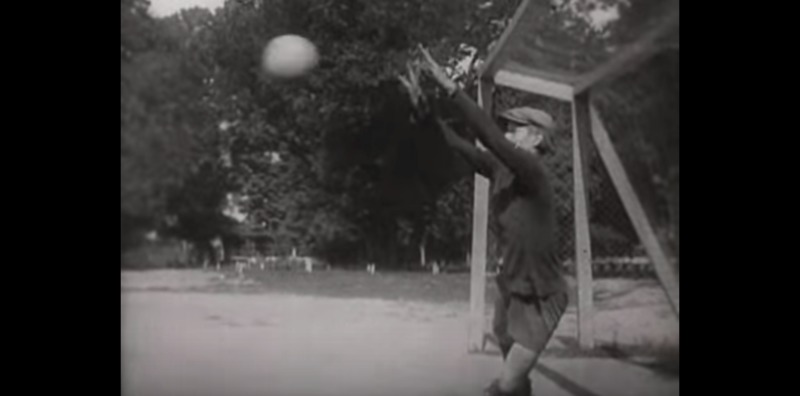
Works that highlight the idea of a city as a harmonious and completely functional utopia take advantage of this omission and inclusion tactic by mainly incorporating positive aspects of the city while excluding anything negative in the work. For instance, Vertov’s film “Man with a Movie Camera” presents a rapidly moving and almost hectic montage of various scenes that Vertov captures while moving through cities. In the film we see fleeting scenes of productivity, happiness, and extreme functionality that presents urbanism as a flourishing and promising phenomenon. We view clips of workers productively operating in an industrial setting, engagement in recreational and athletic activities as seen in the still to the left, and much more in this representation of a “day in the life” of the city. However, Vertov intentionally includes these harmonious and pleasing aspects of the city while deliberately omitting many other events that are certain to be occurring simultaneously. This may include poverty, congestion and density and the city, and economic and social class separations, all of which are known and accepted to be present in most urban environments. By omitting these important and prominent urban aspects and selectively including only those that portray the city as a harmonious utopia, Vertov presents to us a subjectively positive view of urbanism and one that aids us in studying and understanding the city further.
In contrast, an extremely negative view of the city can also be expressed through opposite means such as in Fritz Lang’s “Metropolis,” which portrays a fictional city through highlighting extremely undesirable aspects of a typical city including striking class division and a resulting mindlessness in the lower working classes. We see a pessimistic expressionist depiction of a city gone horribly wrong, which while clearly an exaggeration, makes us aware of Lang’s opinions on urbanism. His choice to include these undesirable facets of the city while excluding many positive aspects like those included in the Vertov film underscores a filmmaker’s ability to make certain choices in his or her work that present subjective and varied viewpoints about the urban experience.
Beyond utopias and dystopias expressed in film, literature is also a fascinating medium to subjectively express the individual’s experience in a city. Literature is actually Preston and Simpson-Housely’s main focus in their essay, and they write,
“The city is a text, waiting to be read and written or rewritten in literary terms… the essential elements of ‘cityness’ are ‘manifested only through feelings: the experience of the environment is always a fusion of the external physical realm and the human being’s internal capacities.’” (3)
Here, Preston and Simson-Housely describe the written means of depicting urbanism as one that effectively incorporates feelings about the city and the city itself. This idea of literature being essential to studying the subjective experience of the city are highlighted by any of the literary pieces we have read in this course. One particularly interesting example is Döblin’s emphasis on anonymity in the city in his novel Berlin Alexanderplatz. As examined in my Berlin blog post, Döblin spends large sections in his work describing the city as a conglomeration of anonymous individuals. Without stating this explicitly, he instead describes scenes within the city, writing,
“Second floor: the caretaker and two fat married couples, his brother and his brother’s wife, his sister and her husband, and a sick daughter too… Third floor a 64 year old man, furniture polisher with bald head. His daughter, a divorced woman, keeps house for him… Next door’s a lather operator, about 30, he has a little boy, living room, kitchen, his wife is dead as well, consumption, he has a cough too…” (4)
It is clear that Döblin deliberately chooses to exclude any mention of names to identify these individuals. Through such exclusion of identity but also inclusion of explicit descriptions of these individuals, Döblin effectively underscores the complex relationships between anonymity and individuality in Berlin. While this specific example of utilizing inclusion and exclusion to subjectively depict a city is more neutral in opinion than the dystopias and utopias discussed prior, all three means of depicting a city highlight the ability that a creator has to control his or her material, which generates fascinating and subjective works that help us in understanding the complexity of urbanism as a whole.
Works Cited
1. The Man with the Movie Camera. Dir. Dziga Vertov. 1929
2. Metropolis. Dir. Fritz Lang. 1927
3. Preston, Peter, and Paul Simpson-Housley. "Writing the City." Blackwell City Reader (2002)
4. Döblin, Alfred. Berlin Alexanderplatz. Olten: Walter, 1961. Print.