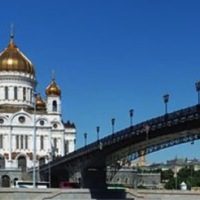
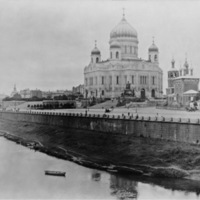
Cathedral of Christ the Savior: Here, Gone, and Back Again
The first stop on our Commemoration-of-1812-Tour-of-Moscouw may seem unlikely, mostly because it can be hard to access this building as an explicit nod to the engagement. But the famed cathedral was ordered to be built following war. After Napoleon's retreat, Tsar Alexander I decreed in December 1812 that Moscow must build a cathedral to honor "Christ the Savior" for keeping Russia safe from the French belligerents. After rounds of changing architectural plans and the succession of the Tsar to Nicolas I, Christ the Savior's building did not commence until 1839.
The massive project not be finished for decades and the Cathedral was finally consecrated in May of 1883. Notably, Tchaikovsky's 1812 Overture was commissioned in conjunction with the consecration ceremonies of the Cathedral. It was first performed in a tent outside the Cathedral just a year before the consecration.
In 1931, under the auspices the Soviet's state atheism and the ongoing attempt to remove major churches from the Moscow skyline, Christ the Savior was demolished. State officials found its excesses, particularly the 20 tons of gold in the dome, to be a display of monumentality and luxury not fit to the moral-aesthetic ideals of the period. In the Cathedral's stead, the Soviets intended to build a massive monument, topped with a statue of Lenin, called the Palace of the Soviets. It was never built.
In 1990, with the fall of the Soviet Union in sight, the government granted permission to rebuild the Cathedral. The project was met with widespread popular demand and the rebuilding received donations from many citizens of Moscow. It was consecrated in its entirety in 2000.
What we see in the Christ the Savior is a memorialization of the War, quite explicitly through the lens of different institutions with different ideologies. The original Cathedral is remarkable in its sheer monumentality and religious expression. Its glittering gold domes and grand scale demonstrate an aspiration to power in Tsarist Russia, whose defeat of Napoleon's army generated a swell of nationalistic pride that required expression in the sort of spectacular form that the Cathedral represented. Further, it exhibits the inherent connection of this power to the symbolism of the Church. But, during a different regime with a different agenda, this style of commemoration of the Patriotic War of 1812 seemed unfit, even egregious. To the Soviets, the lavishness of the Cathedral was so gauche a memory of Russia-past that it needed to be destroyed. By the time Russia emerged from the Soviet period, there was such an intense desire for a authentic cultural expression of historical Russia -- one that could transcend the cultural project of the Soviets -- that it only made sense, even before the fall of the USSR, to begin plans to rebuild Christ the Savior.