Poklonnaya Hill (Victory Park): 1812 on Grand Scale
As the story goes, Napoleon, upon his Army’s invasion of Moscow proper, posted atop Poklonnaya Hill and waited for the Russians to bring him the keys to the city.[1]
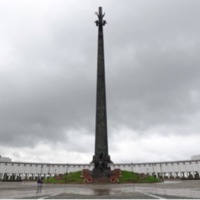
They never did. As a symbolic nod to this moment, the Soviets decided to develop the area as a kind of open-air museum to the 1812 victory. Beginning in the 1960s, a suite of projects brought different commemorations of The Patriotic War, from across the city, to this centralized area. The Triumphal Arch was relocated nearby the hill. Franz Roubaud’s Battle of Borodino was installed in the area. In the 1990s, an obelisk was erected whose exact height is 141.8 meters, 10 cm for every day of the war. In the post-Soviet period, an Orthodox church, a memorial mosque, and a Holocaust Memorial Synagogue were all build on the premises.
The vast scale and non-ornamental monumentality of Victory Park distinguish it as the most distinctly Soviet-seeming commemoration of the Patriotic War of 1812 in Moscow. Its monuments eschew the glittering romantic excess that we find in the monuments of earlier periods in favor of a sheer impression of size. The commemorative site is structured as a “park” and is intended to be occupied by people, but the scale of the park seems to lack a sense of humanism. That is, there seems to be little for people to interact with on a reasonable human scale and little to encourage engagement with the environment and with other people in the park. It massive open space for demonstration and parade creates vacuum in the urban fabric. It’s somewhat alienating. Insofar as this can be read as a distinctly Soviet monumentality, it seems as if Victory Park almost is intended to express the power of the state in relation to its people – its power to overcome history and bring diverse relics from across time to one place, its power massive monuments (whose monumentality is encoded in the exact specifications of its verticality) – all of which loom large around the visitors.
[1] Information on Poklonnaya Hill from Murrell, Berton Kathleen, et al. “Moscow – Cultural Life.” Encyclopedia Britannica. 2016. Online.
Wikipedia contributors. "Poklonnaya Hill." Wikipedia, The Free Encyclopedia. Wikipedia, The Free Encyclopedia, 11 Dec. 2016. Web. 11 Dec. 2016.