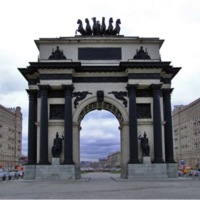
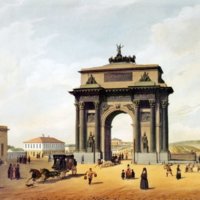
Triumphal Arch: Around the City, Over Time
The triumphal arch is a popular monumental form. It dates back to Rome, where it was used to commemorate major military and political events. We find the triumphal arch all about the West, perhaps most famously in Paris’ Arc de Triomphe along the Champs-Élysées.
In Moscow, we also find a spectacular iteration of this popular form. In 1814, shortly after the Russian victory in 1812, a wooden Triumphal Arch was built near the Tver Gates to commemorate the triumph over Napoleon’s army.[1]
The wooden monument soon faced structural problems and, 1826, it was decided to replace it with a stone version. From 1829-1834, architect Joseph Bové oversaw the construction of the new arch, still at the Tver Gates location. The inscription lauds Alexander I for his “paternal” leadership over the “Gauls” (the state of monumentally clearly still taking direct cues from Roman history here).
As with Christ the Savior, the Triumphal Arch was dismantled as part of the Stalinist/Soviet reconstruction of Moscow. It was demolished in 1936, just over 100 years after its completion. Beginning in 1966, Soviet officials commenced plans to rebuild the Arch. By the November 1968, Arch was finished, built to Bové original designs, in a new location: the middle of Kutuzovsky Avenue, leading toward Victory Park and Poklonnaya Hill.
In the Triumphal Arch of Moscow we see a similar path through history to the Cathedral of Christ the Savior – erected under the Tsarist regime and demolished under the Soviets. However, there’s an important difference in its history: unlike Christ the Savior, the Triumphal Arch was rebuilt under the Soviets. It seems that this fact represents an important kernel of Soviet commemorative ideology. In rebuilding the Arch to its original designs, it seems the Soviets were comfortable with commemorating the victory of 1812, even though it tended to glorify the Tsarist leaders of the past. On the other hand, they never motioned, until the collapse of the USSR was eminent and fast approaching, to rebuild Christ the Savior. This points to a perhaps important distinction: the Soviets weren’t opposed to monumental commemoration of 1812, but were opposed to the explicitly religious monumentality represented by Christ the Savior. The Roman monumental style of the Triumphal Arch was still deemed appropriate in Soviet Russia. This might suggest something important about the Soviets’ symbolic self-understanding and their larger cultural-aesthetic project.
[1] Information in this page derived from “Trimphal Arch in Moscow.” Mesuem.ru. http://www.museum.ru/museum/1812/English/Memorial/arka/index.html. Reaccessed December 12, 2016.
Wikipedia contributors. "Triumphal Arch of Moscow." Wikipedia, The Free Encyclopedia. Wikipedia, The Free Encyclopedia, 10 Nov. 2014. Web. 10 Nov. 2014.