Introduction
"The beauty of Post Office Square isn't simply that it's a destination, a place for people seeking a shady spot to eat lunch: It's also a crossroads -- a welcoming, accessible concourse where people's paths converge. You could be going about your business, and suddenly you happen on this wonderful refuge. The opportunity to take a moment to rest and to sit quietly in nature, or to watch the human theater around you -- those are the things that the best public spaces provide.”
- Alex Krieger FAIA, Principal, Chan Krieger NBBJ; former Chair, Harvard University, Department of Urban Planning and Design.
Post Office Square is a triangular plot of land in Boston’s packed financial district, nestled between the brief divergence of Pearl and Congress Streets. Its space is filled by Norman B. Leventhal Park, a tiny strip of greenery whose size belies its stature.
The square forms a momentary gap between the heavy towers of Boston’s financial district. Rays of light do not reach its lawn until midmorning, when the sun breaks through the buildings. The square and its park appear trivialized by its surroundings, a courtyard dwarfed by looming battlements.
A quick online search, however, tells a different story. “Post Office Square Park has changed Boston forever,” Boston Globe architect Robert Campbell wrote in a 2004 review, which he titled “The Perfect Park.”[1] Other critics echo Campbell’s praise: over its 23-year lifespan, the park has received accolades ranging from the American Planning Association’s “Great Places in America” designation to the American Society of Landscape Architects’ 2014 Landmark Award.

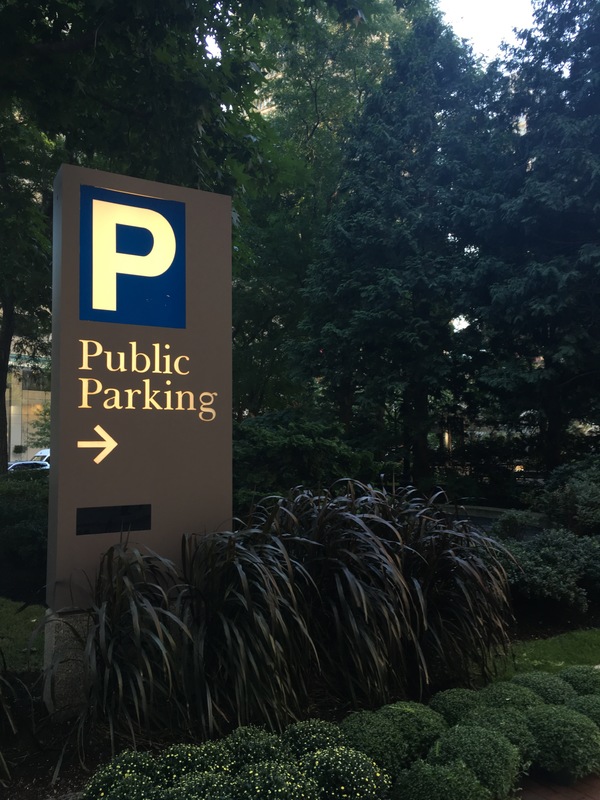
This acclaim is predicated on a common understanding of the park as a triumph of urban renewal. Forty years ago, Post Office Square was not home to a park, but to a parking garage. Today, that parking garage lies beneath the park, creating a mixed-use space where pedestrian and motor traffic coexist and cooperate.
This exhibit will examine the critical discourse of Norman B. Leventhal Park as both urban redemption and urban solution, and how this designation has shaped—and been shaped by—the evolving identity of Post Office Square as public space. The square can be viewed as a self-conscious palimpsest whose layers of history, design, and use speak to a cyclical pattern of construction, blight, and attempted renewal. Its successive iterations represent increasingly conscious attempts by Boston’s urban planners to revitalize the downtown’s urban identity. Using this framework, I hope to reach a nuanced understanding of how the square both inhabits and influences the landscape of downtown Boston.