Urban Symbiosis
The garage was intended to provide parking for the surrounding Financial District. Ultimately, however, it would emerge as an example of what urbanist Richard Sennett would call “over-determined form.” Its limited capacity rendered it unable to adapt to shifting demands in local traffic, and its utilitarian form and physical unattractiveness made it a disrupting influence for pedestrians. A unilateral solution to an urban problem, it exemplified Sennett’s warnings that such structures would develop “dinosaur-effect”: a form of urban blight where “the dead dinosaur which human beings have built… begins to deaden the space around it.

The garage’s ultimate failure lay in its inability to accommodate downtown Boston’s evolving need for public space. Post Office Square functions as an urban “solution” to this issue: it offers both parking and recreation, creating a nuanced alternative to the former structure’s unilateral and monolithic purpose. Its ability to address both problems is the product of conscious design, informed by the site’s history as a palimpsest of periodic urban blight.

Further, the site’s two functions not only coexist, but symbiotically enhance one another. Proceeds from the underground garage are dedicated towards park maintenance, and garage users exiting into the park provide additional pedestrian traffic. “The garage functions like a gusher,” Robert Campbell wrote for the Boston Globe, “spuming people and activity continually upward.”
This is in keeping with Richard Sennett’s thoughts on creating “porous,” or open, public spaces. Even though he recognized that traffic infrastructure such as highways could cause stagnation by created closed “boundaries” within cities, he also warned that “banishing traffic tends to homogenize urban space”—in other words, without road access, “pedestrian zones become shopping malls rather than serving the complex needs of production and work as well as consumption."[1]
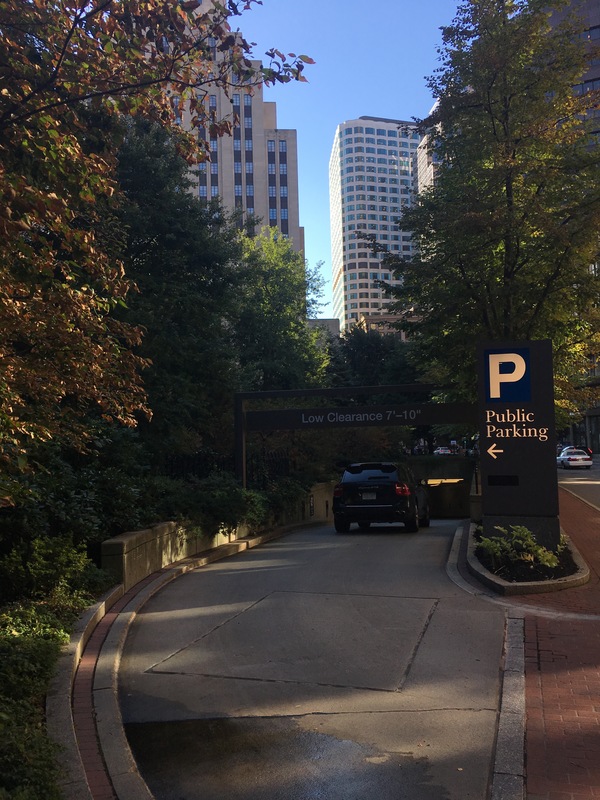
As a hybrid space serving both these needs, Post Office Square largely addresses Sennett’s concerns. There are limits to this symbiosis: the park’s green space is hemmed in on either side by parking ramps, resulting in a more compact experience than the sprawling expanse of nearby Boston Common. All in all, however, it represents an admirable attempt to balance the multifaceted needs of an evolving downtown center—a truly “open” public space, and a worthy addition to the palimpsest.
[1] Richard Sennett, "The Public Space." The Blackwell City Reader, 2nd Ed. (2010): 261.