Urban Trajectories
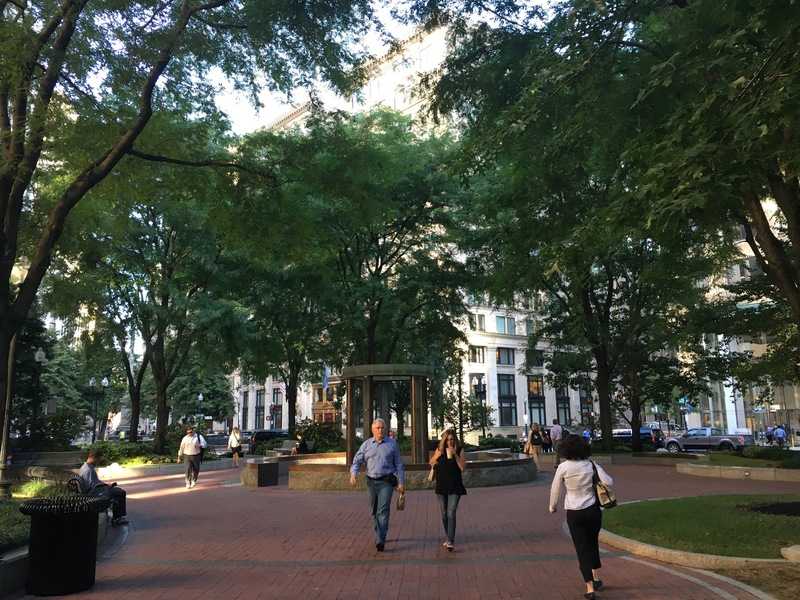

I visited Post Office Square early in the morning. Traffic was still light, and the first pedestrians had only begun to trickle out of the various office buildings surrounding the park. As I stood within the central green space, admiring the fountain, I noticed an emerging pattern in the foot traffic within the park—one that revealed an additional layer of intentionality in its design.
The square abuts two intersections—Congress and Franklin, and Pearl and Milk. These can both be viewed as “nodes,” or focal points for the pedestrian traffic of office workers on their morning commutes. Norman B. Leventhal Park lies directly between these two intersections; a path stretches roughly from one to the other, creating a diagonal “shortcut” that represents the path of least resistance between the two.
Pedestrians within the park thus become what Michel de Certeau calls “Wandersmänner” in his essay “The Practice of Everyday Life” [1]: by following this path, they become unintentional practitioners of “an ‘urban text’ they write without being able to read it.” As Certeau points out, however, analyzing only the trajectories of walkers ignores the observational nature of their experience—what he calls “the act of passing by.”

With this in mind, the park’s design seems geared towards shaping and enhancing this experience. It funnels unsuspecting pedestrians through both of its major “spaces”: a grassy lawn, and a tree-lined central circle and fountain. The paths they walk along, as well as the benches and railings, are all curved in gentle arcs, in contrast to roads outside the park that are laid out in straight lines.
The park’s status as palimpsest helps us understand the rationale behind these design choices. When envisioning the new Post Office Square, the park’s designers would surely have been aware of the pressing need for green space amidst the densely packed environment of the Financial District. The park’s paths provide a contrast alternative to the haphazard, angular streets surrounding it, which were erected largely at random through successive economic booms and the flurry of rebuilding in the wake of the fire.
In short, these design choices shape de Certeau’s “urban text" by modifying its historical status quo. They recognize the pressures created by the Financial District's layers of development, and work to relieve these pressures for its inhabitants.
As I stood in the park’s central theater, watching the pedestrians, I heard a brief hiss from the center of the plaza. With a rush, its fountain whirred into life.
[1] Michel de Certeau, "The Practice of Everyday Life." Blackwell City Reader, 2nd Ed. (2010): 112