Static vs. Dynamic
"In the public realm, openness can be defined in terms of built fabric and its context; in the focus on membrane/borders rather than boundaries or centers; in the response of urbanities to difference, and to anonymity."-Richard Sennett, "The Public Realm"
Under the framework of the city as a palimpsest and through the lens of Sennet and his notion of membranes that both separate and facilitate interactions between different elements in a city, the South End Burying Ground can be interpreted as a partial palimpsest that reflects different layers of meaning, from the layers of history to the physical layers that constitute the site. One can argue that it is an evolving palimpsest, albeit one that has become more and more static through the years because burials here had ceased since 1866, but changes still occur through the passage of time, as reflected by the weathering of the tombs and the growth of the vegetation.
Multiple, different layers from history are in dialogue with each other at this site. Specifically, the pristine appearance of the present site is undermined by the actual history of the site as a burial ground for the lower echelons of society. There are also physical layers that are juxtaposed on top of each other, such as the soil that bears the remains of people, the flat and bevel markers that lie close to the ground, the headstones that stand on top of the graves, and the trees that are the tallest elements in the space, casting shadows over all the grave markers, even the large monument-like tombs.
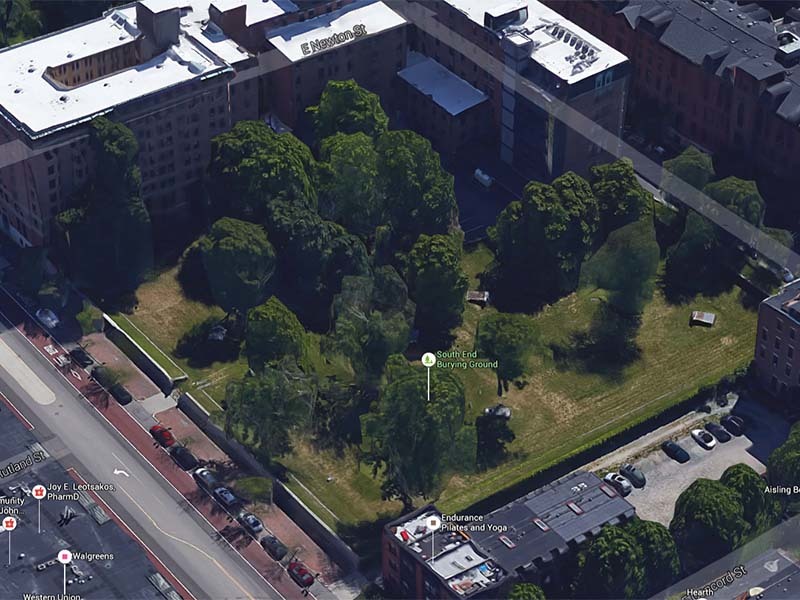
While graveyards are typically regarded as static sites where the dead go to rest, they can also be regarded as dynamic in the sense that there are more people who are buried there everyday, maintaining a connection with the present day through the continuous burying of people who have recently passed away. Moreover, its static nature is bolstered by the fact that "interments ceased in this graveyard in 1866," rendering the South End Burying Ground more static today than in the 19th century (1). Yet, it is interesting to note that this site remained somewhat dynamic in the first few decades after its establishment, for the "successive filling of the marshy site permitted burials in several tiers (3). This dynamism that stemmed from the “burials in several tiers” establishes the site as a literal palimpsest because it contains overlapping layers of actual bodies from different periods of time although this layering of elements cannot be directly observed. Furthermore, the site evolved through time, as most of the 150 tombs constructed originally to create a wall around the perimeter of the cemetery are mostly gone now (5). However, traces of these tombs remain, such as one white marble marker to the left of the entrance gate, linking to the idea of the site as a palimpsest.
Furthermore, a sense of life and dynamism is reflected in the sounds that permeate the space. In the background, there are birds chirping, leaves rustling gently in the wind, and vehicles whirring in the background. The noises from the cars driving past by the cemetery, mostly on the busy Washington Street, were especially prominent, disrupting the serenity of the graveyard, which resembles a private park with its seclusion and greenery. The leaves fluttering in the wind were the also quite noticeable, serving as a reminder of the vibrancy of life. These multiple sounds, some artificial and some natural, can be perceived as different layers of meaning because they overlap and interfere with each other as one experiences the stillness of the site. Thus, the lively movements of the leaves struck a sharp contrast to the stillness of the actual graveyard.
(1) http://www.cityofboston.gov/parks/hbgi/SouthEnd.asp
(3) http://www.interment.net/data/us/ma/suffolk/south-end-burying-ground.htm
(4) Richard Sennett, "The Public Realm"
(5) http://www.findagrave.com/cgi-bin/fg.cgi?page=pis&PIcrid=2211477&PIpi=110865027&PIMode=cemetery