Creation

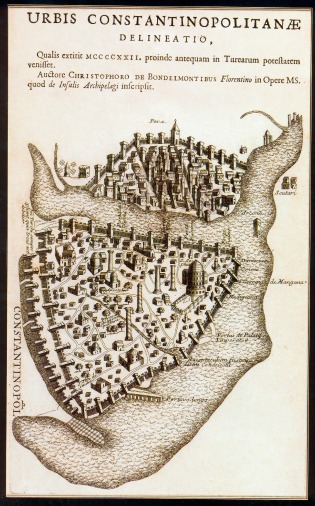
In 330 AD, the city under Constantine was renamed Constantinople, and he began to focus the city on being a capital of the world, especially starting from the ports and harbors through cultural exchange and trade. Prior to the Theodosian Harbor, Emperor Constantine built the Eleutherius Harbor, which would be the location for the Theodosian Harbor later once there was a different emperor. The importance of docking ships and trade would go on to be crucial once the emperor Theodosius I came into power. He would name the harbor that he built in the 4th century AD after himself, the Theodosian Harbor. The harbor was located on the Marmara shoreline, which lies between Europe and Asia, and provided the harbor with a prime location for trade. It quickly rose into prominence as a key port for the Byzantine Empire and Constantinople.
The preservation of the site, whether it is the Eleutherius Harbor or the Theodosian Harbor, provides a context for it as a lieu de memoire through Nora's definition. Through the 4th century to the 5th during the reigns of Constantine and Theodosius, the harbor represents the Byzantine Empire at its most expansive, its most international, and the most culturally and commercially connected to the various parts of the globe at the time. The harbor's material existence is a strong memorial heritage and reminder of the goals of the 4th century Byzantine Empire at the start of the empire and its power.
Nora, Pierre. "Between Memory and History: Les Lieux De Memoire." Representations 26.1 (1989): 7-24. Web.
Pearson, Charlotte L., Carol B. Griggs, Peter I. Kuniholm, Peter W. Brewer, Tomasz Ważny, and Leann Canady. "Dendroarchaeology of the Mid-first Millennium AD in Constantinople." Journal of Archaeological Science 39.11 (2012): 3402-414. Web.