Shifting Priorities: Road Building Commission
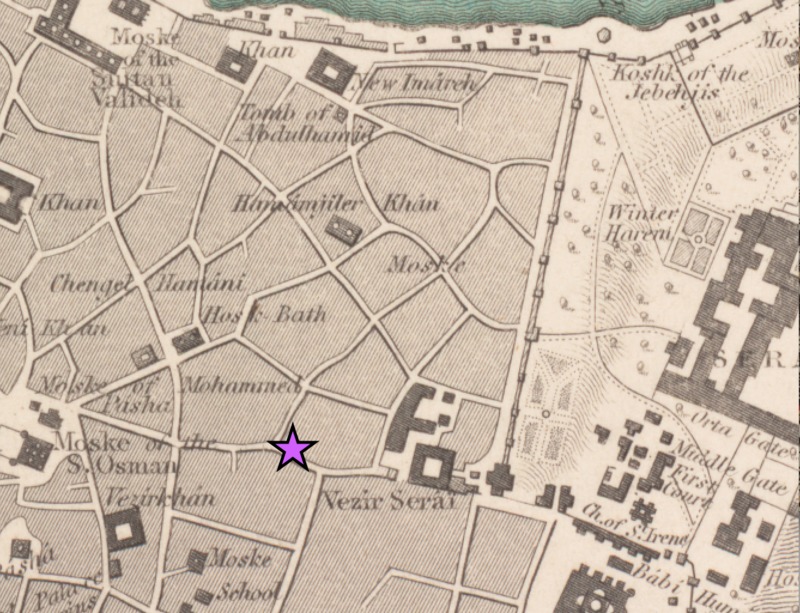
The site of Cemberlitas hamam lies on a particularly influential street of Istanbul. Danyolou street serves as a central artery for access to the Sultan’s palace, as well as to notable religious institutions and commercial sites. Thus, between 1835 and 1839, the city’s urban planners were forced to reflect on the practicality and need for the institutions dotting the street in light of a road improvement commission. (1) The commission, comprised of 9 government officials, were part of industrialization wave that swept the city. The need for better urban infrastructure included a call to widen the famously narrow and convoluted Istanbul streets from 3.8 meters to 19 meters. (2) The magnitude of such an endeavor required a systematic overview of the crucial aspects of the city and selection of which sites would need to be impacted in construction. Following a deadly fire that stormed through Danyolou street in 1865, the commission decided to impact the school of Atik Ali Pasa mosque and a corner of the women’s section dome for the bath house. The commission severely affected Cemberlitas operations as it forced the closure of the women’s section, half of the clientele of the bath house.
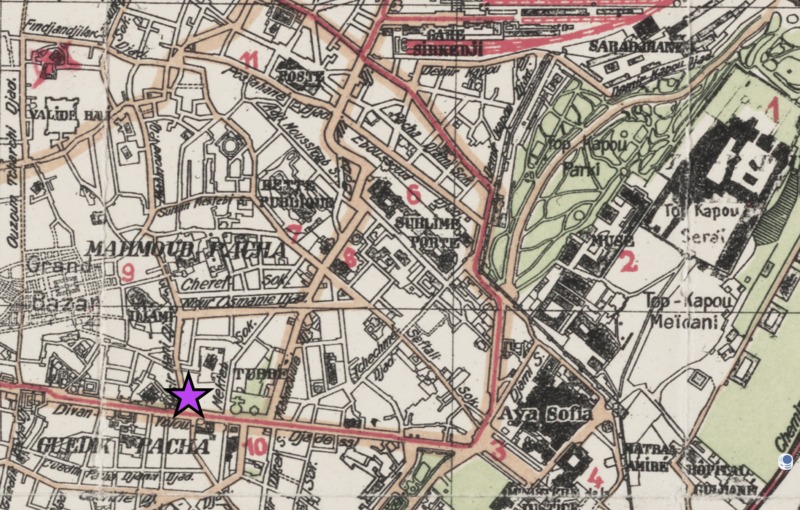
The decision to impact a fraction of the Cemberlitas bath house was partially a reflection of Istanbul society’s shift towards progressive urban policies and selective historical memory. The commission represented a desire for a new urban space, one that sought to rival Western political powerhouses such as the United States and western European countries. A noticeable trend was that city planners sought to prioritize cultural relics that they believed were tied to the West, such as Classical Ancient and Byzantine period sculptures. (3) Thus, their exclusion of Cemberlitas hamams as a centerpiece of desired culture provides an insightful glance on how the site was associated with a less desired societal memory. It was a remnant of a culture that progressive planners wanted to shape and mold after other leading countries. The reduction of Cemberlitas female customers until the women’s section rebuilding in the late 20th century pointed to the decline in use of the site. The fact that the bath house did not invest the capital to incorporate another female dressing room to compensate for the lost space signals that it ceased to be as socially enticing as it once was. As the site faced a slow decline in popularity, the clientele shifted from those who wished to engage with the community to those who strictly needed the practical hygienic benefits of cleanliness.
(1) Cichocki, Nina. “The Life Story of the Çemberlitaş Hamam: From Bath to Tourist Attraction.”ProQuest Doctoral Dissertations. 2005. http://hollis.harvard.edu/primo_library/libweb/action/display.do?tabs=detailsTab&ct=display&fn=search&doc=TN_proquest305472062&indx=1&recIds=TN_proquest305472062&recIdxs=0&elementId=0&renderMode=poppedOut&displayMode=full&frbrVersion=&frbg=&&vl(51615747UI0)=any&vl(1UI0)=contains&dscnt=0&scp.scps=scope%3A%28HVD_FGDC%29%2Cscope%3A%28HVD%29%2Cscope%3A%28HVD_VIA%29%2Cprimo_central_multiple_fe&tb=t&vid=HVD&mode=Basic&srt=rank&tab=everything&vl(394521272UI1)=all_items&dum=true&vl(freeText0)=Çemberlitas%20Bath&dstmp=1478385709237
(2) Celik, Zeynep. “The Remaking of Istanbul: Portrait of an Ottoman City in the Nineteenth Centruy.”
(3) Cichocki, Nina. “The Life Story of the Çemberlitaş Hamam: From Bath to Tourist Attraction.”ProQuest Doctoral Dissertations. 2005. http://hollis.harvard.edu/primo_library/libweb/action/display.do?tabs=detailsTab&ct=display&fn=search&doc=TN_proquest305472062&indx=1&recIds=TN_proquest305472062&recIdxs=0&elementId=0&renderMode=poppedOut&displayMode=full&frbrVersion=&frbg=&&vl(51615747UI0)=any&vl(1UI0)=contains&dscnt=0&scp.scps=scope%3A%28HVD_FGDC%29%2Cscope%3A%28HVD%29%2Cscope%3A%28HVD_VIA%29%2Cprimo_central_multiple_fe&tb=t&vid=HVD&mode=Basic&srt=rank&tab=everything&vl(394521272UI1)=all_items&dum=true&vl(freeText0)=Çemberlitas%20Bath&dstmp=1478385709237