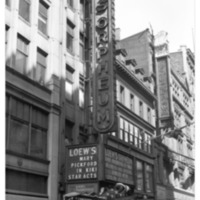
Orpheum Theater Location and Concept of a "Closed" Space
To understand the importance of the Orpheum Theater is to understand the colorful cultural layers underneath its current state. The history of the theater, a progression of unique repurposements reflecting the changing tide of popular culture and tastes of Bostonians, is what gives this theater its importance.
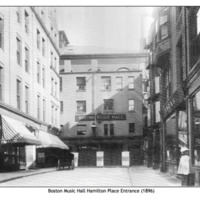
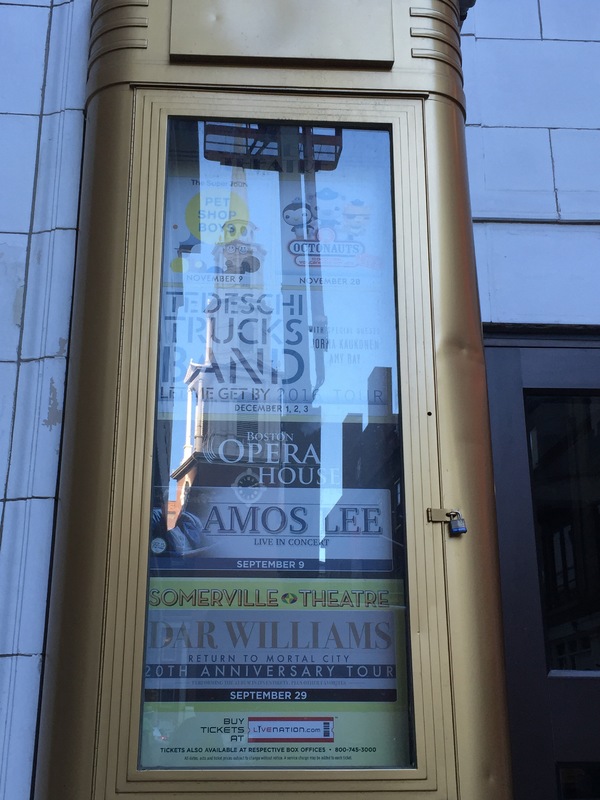
The unusual location of the theater and its cramped surroundings is the most immediately striking element of ones visit. Strolling through the streets of Boston, one may find the theater oddly tucked away from the general hustle and bustle of the city. On the corner of Tremont Street, the present day theater sits between Suffolk University dorm housing and a cheap center for fast food chains called “The Corner." The long, narrow strip called Hamilton Street leads to the entrance, barely two cars wide. At the end stands the theater sandwiched between two buildings of widely different uses, educational and consumption oriented. The famous Park Street Church, a famous conservative congregational church built in 1809, stands directly across the theater.
Since its inception, the theater was constructed in the middle of an urban landscape with brimming buildings surrounding it on Tremont, Washington, Winter and Bromfield Streets. The location amidst other well-established locations such as the Park Street church was not a coincidence: the main patrons of the hall were the wealthy elite, those with townhouses on nearby Beacon Street and patrons of the Church to its behind. Under Richard Sennet’s classification of spaces, one would preemptively believe the theater to be a “closed system,” a highly structured establishment built in a pre-determined way for a singular purpose. A main characteristic of a closed system is rigid boundaries and the inability to expand its physical form. In this strict definition of a closed system, the Boston Music Hall satisfied these prerequisites: the goal of its founders was to create a large seating hall that would be a prominent hub for the city’s music scene in the heart of a highly populated area.
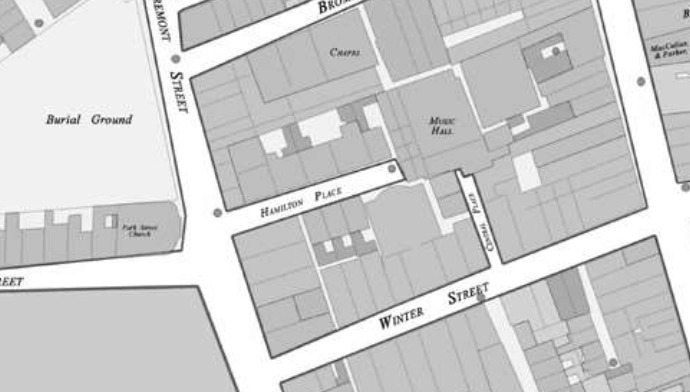
The Hall was indeed subjected to tight real estate constraints, making physical expansion not a possibility. If anything, real estate could easily be shrunk in the competitive real estate landscape it was built in. Such was the case with the Hall’s two original entrances, one on Winter Street as the main entrance and one on Hamilton as a back entrance. Due to financial turmoil in 1916, the front entrance was abandoned and incorporated into an adjacent department store. The theater thus established its secluded back entrance as its front entrance, explaining the limited and cramped street still used today. The theaters original location placement would prove to provide an interesting challenge to the theater. In order for it to be a viable venue and adapt to cultural changes in the future, it would need to resolve its “closed space” dilemma with alternative, creative solutions for repurposement.