The Rise of New Entertainment Forms and Creative "Open" Space

The third artwork, flanking at the very right of the facade, features one person playing music and the other dancing, suggesting a tribute to theatrical entertainment and thus to a new era of the Boston Music Hall. Venturing inside the theater, one finds the historically renown organ from Boston Brahmin times nowhere to be found. Instead, the performance area of the theater has a large stage with a ornate golden frame and a stage primed for performance. The insides of the Hall, without a trace of its orchestra chamber and grand organ, signify two more waves of culture shifts that the Hall endured.
As quickly as the Organ’s popularity rose, popular Bostonian culture shifted away from it. The newest fad of the late 19th century was orchestral music and the Boston Symphony Orchestra blossomed in popularity. Boston Music Hall was the home of the Boston Symphony Orchestra from 1881-1900, attracting high end customers to its talented renditions of Beethoven, Mozart and Mendelssohn. The first of many internal space alterations went underway. In 1885, the once famous organ was removed in favor of larger stage space for the symphony.
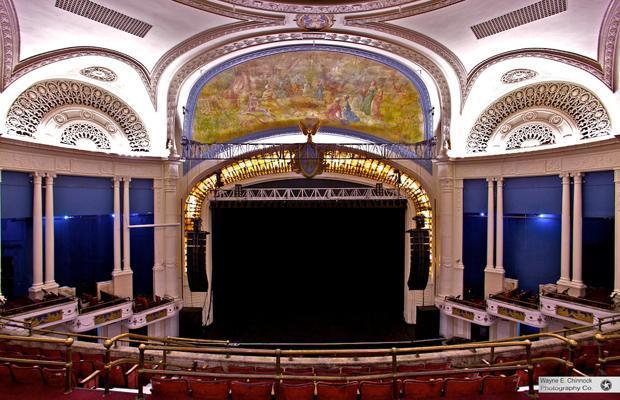
As successful as the Hall was with musical entertainment, it was threatened by technological advancement. Due to subway construction and road building, the Boston Symphony company left the hall for a newly created Symphony Hall. This forced the theater into a crucial decision point: it could stay as a “closed space” doomed to its original purpose of a musical hall and wait for a new musical company to inhabit its space, or creatively change its purpose to attract a new form of entertainment to its venue. Thus, the entire purpose of the hall was once again reimagined. A real estate developer by the name of R.H. Allen converted the Hall into a vaunderville theater. The movie theater phase was sweeping the nation as the trend of silent film was just taking flight. With it, the Hall soared to new heights: by 1900, all that was left of the Hall’s interior were its box seats to make way for film projection. For the following two decades, the Hall was entirely redesigned into a premier movie theater, handed down between multiple managerial hands. The most notable of which was Marcus Loew’s acquisition in 1916, where the theatre showed feature length films thus becoming Boston’s center for film viewing. Under Loew’s management, architect Thomas Lamb designed a new layout for the interior space: the renovated theater was to be designed for maximum capacity. In fact, the modern day proscenium arch made of golden glass with intricate detailing and illumination reflects Lamb’s design for the theater, a new arena for projections. The theater was renamed the Orpheum Theater, an exterior reflection of the hall’s ability to creatively change its purpose without the need of brick and mortar expansion.