Byzantine Revival

Church of the Holy Trinity at the Borisovo Ponds
For the last stop of the tour, we’ll travel to Orekhovo-Borisovo a residential district to the south of Moscow. Located in Orekhovo-Borisovo, the Church of the Holy Trinity at the Borisovo Ponds was also built in 2004 to accommodate for the lack of orthodox institutions in Moscow. Architecturally, the church is significant because it is considered one of the most prominent examples of Byzantine revival architecture in the 21st century.
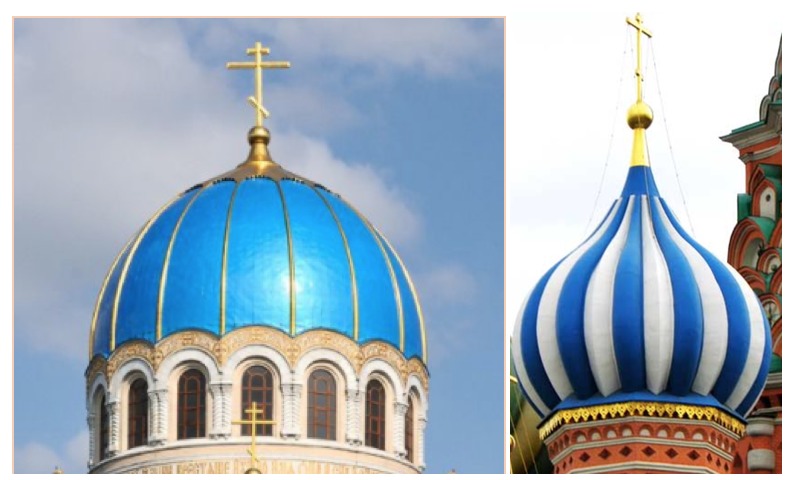
Specifically, there are two structural elements that differentiate this church from more traditional Russian Orthodox churches: the dome and the arches. Unlike traditional Russian Orthodox Churches like Saint Basil’s Cathedral, the dome of this church is hemispherical rather than onion-shaped. Many Byzantine revivalists considered these domes to be more cost effective and sturdier than the onion shaped domes of traditional Russian churches. Additionally, like many Byzantine churches, the Church of the Holy Trinity at the Borisovo Ponds blends arches and domes together (2). When looking at the bottom edges of the center dome, the edges are supported by arches and pillars rather than formal cornices. These arches expose significant natural light into the interiors of the church (3). Despite these structural differences, the church still retains a sense of Russian authenticity. Just like the candy-colored domes of Saint Basil’s Cathedral, the domes of this church utilize similarly vibrant colors. In combination, these elements create a unique structure that combines both Byzantine revival architecture and traditional Russian Orthodox elements.
1) Jackson, Thomas Graham. Byzantine and Romanesque Architecture. New York: Hacker Art, 1975. Print.
2) Banerjee, Jacqueline. "The Byzantine Revival." The Byzantine Revival. Victorian Web, n.d. Web. 23 Oct. 2016
3) "Dome." Encyclopedia Britannica Online. Encyclopedia Britannica, n.d. Web. 23 Oct. 2016.