Clear the Way for Parades
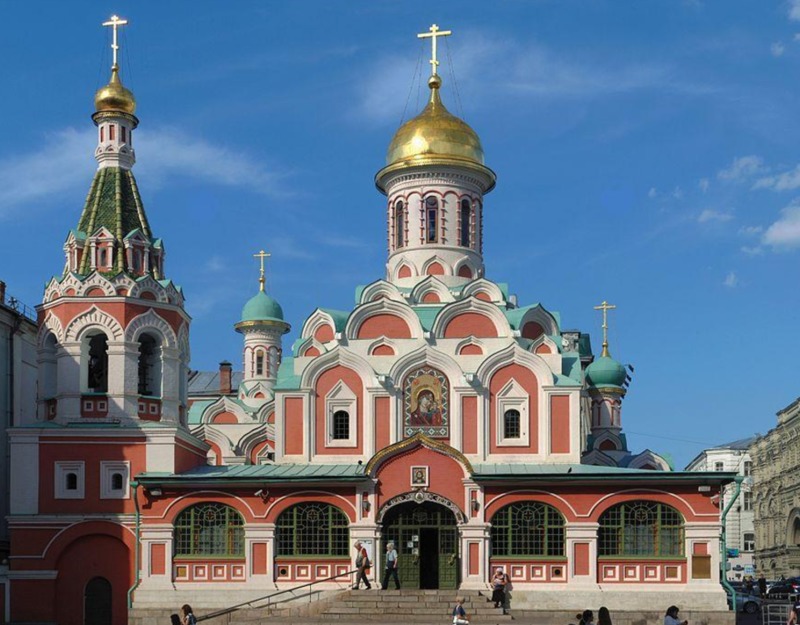
Kazan Cathedral
The next church on our tour is also located on the Red Square. Originally constructed in 1625 by the Prince Dmitry Pozharsky after his victory over the Polish-Lithuanian Commonwealth, the church was intended to be a tribute to the Virgin Kazan. For centuries, the church held a patriotic significance to many Russians because it represented the country’s independence from Poland-Lithuania (1).

However, during the early 20th century, Joseph Stalin ordered the demolition of the church not only because he wanted to make way for military parades but also because he viewed the Russian Orthodox Church as a threat to the country’s communist ideology (2). Nearly 60 years after its destruction, in 1993, the Kazan Cathedral became the first Russian Orthodox Church completely rebuilt after the collapse of the Soviet Union.
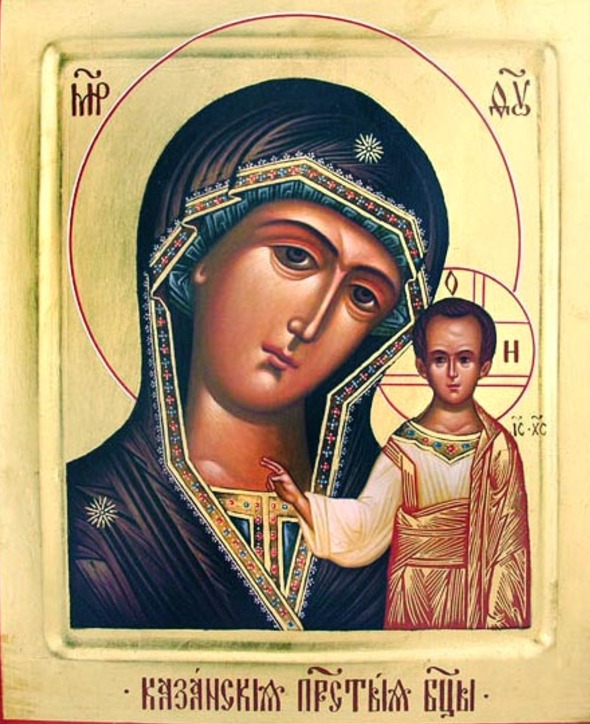
The new Kazan Cathedral was constructed with likeness to the original design but also incorporated several traditional Russian Orthodox elements like an emphasis on icons (3). The architect Oleg Zhurin attempted to construct the church with similar colors to the original design: the exterior was painted pink and white and the domes were painted with clusters of green and gold. Similar to Saint Basil’s Cathedral and many other traditional Russian Orthodox churches, Kazan Cathedral also incorporated many icons throughout the church. Right above the entrance, a larger than life icon of the Virgin Kazan welcomes visitors into the church. Additionally, inside the church, the walls are lined with many golden murals depicting the Virgin Kazan, reflecting the importance of icons to the orthodox church. Throughout its demolition and reconstruction, the Kazan Cathedral portrays the influence that the government has had on the Russian Orthodox Church.
1) "The Kazan Cathedral." Kazan Cathedral on Moscow's Red Square. N.p., n.d. Web. 23 Oct. 2016.
2) "4 November." November 4. On This Day, n.d. Web. 23 Oct. 2016.
3) Brooke, Caroline. Moscow: A Cultural History. New York: Oxford UP, 2006. Print.