The Tallest Orthodox Church

Cathedral of Christ the Savior
Similar to Kazan Cathedral, the history of the Cathedral of Christ the Savior depicts the relationship between politics and religion throughout Moscow’s history. Just like Kazan, the Cathedral of Christ the Savior was constructed before the Soviet era to commemorate a military victory. Originally built in 1883 by Tsar Alexander I, the cathedral was constructed in honor of Christ the Savior after Alexander I defeated Napoleon during his invasion of Russia (1). In fact, in the interior of the original church, marble plaques with the names of military leaders in the War of 1812 line the walls.

As one of the tallest monuments in Moscow, the cathedral stood as a proud symbol of the Russian Orthodox church. When communism came to power in the early 1900’s, religion was viewed as a “counter-revolutionary” institution with a significant independent influence over society (2). Because leaders like Stalin and Lenin viewed religious ideology as antithetical to communist ideology, the government decided to demolish religious influences across the country and replace them with those that stood for communist values. Since the Cathedral of Christ the Savior was one of the most prominent Russian Orthodox monuments, Stalin selected the church as one of the first to be demolished. In 1933, the church was dynamited, and in its place, Stalin began plans for constructing the Palace of Soviets.
Demolition Video
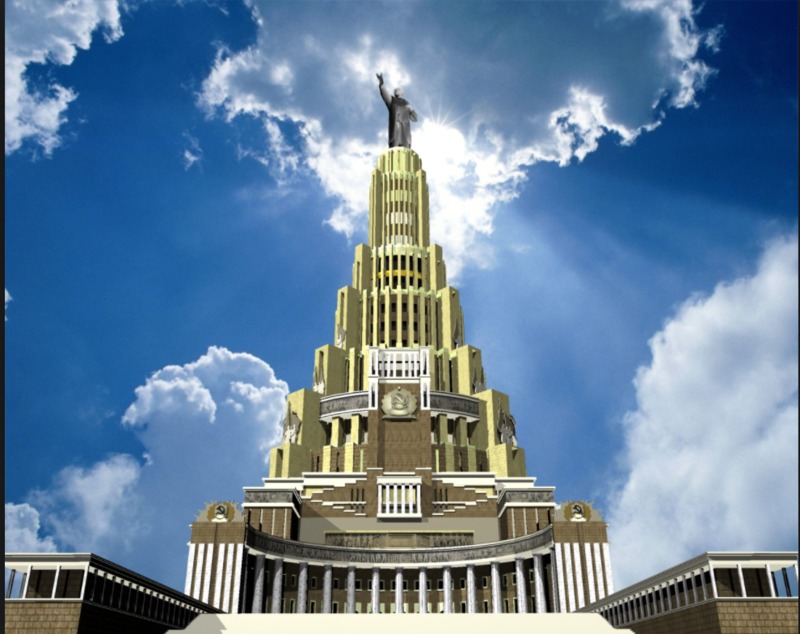
Originally designed to be the tallest structure in the world, the Palace of Soviets was intended to be the shining representation of communism – an administrative and governmental center for Moscow. Despite ambitious plans, the palace was never formally constructed (3). Instead, the world’s largest open air swimming pool was built in its place. In 1995, after the fall of the Soviet Union and extensive collaboration between the orthodox church and Moscow city government, the Cathedral of Christ the Savior was rebuilt on the site. At the time of reconstruction, the architect, Aleksey Denisov, constructed the palace as a nearly exact replica to the original church. Ultimately, the Cathedral of Christ the Savior captures the unique relationship that the Russian Orthodox Church has had with the changing governments of Russia.
1) "The Cathedral of Christ the Saviour." Moscow's Cathedral of Christ the Savior. N.p., n.d. Web. 23 Oct. 2016.
2) Pankhurst, Jerry. "Religious Culture: Faith in Soviet and Post-Soviet Russia."University Libraries. University of Nevada, 2012. Web. 23 Oct. 2016.
3) "Sacred Destinations." Cathedral of Christ the Savior. N.p., n.d. Web. 23 Oct. 2016.